


Ivermectin, Fenbendazole and Mebendazole in Metastatic Cancer: Mechanisms vs Clinical Evidence

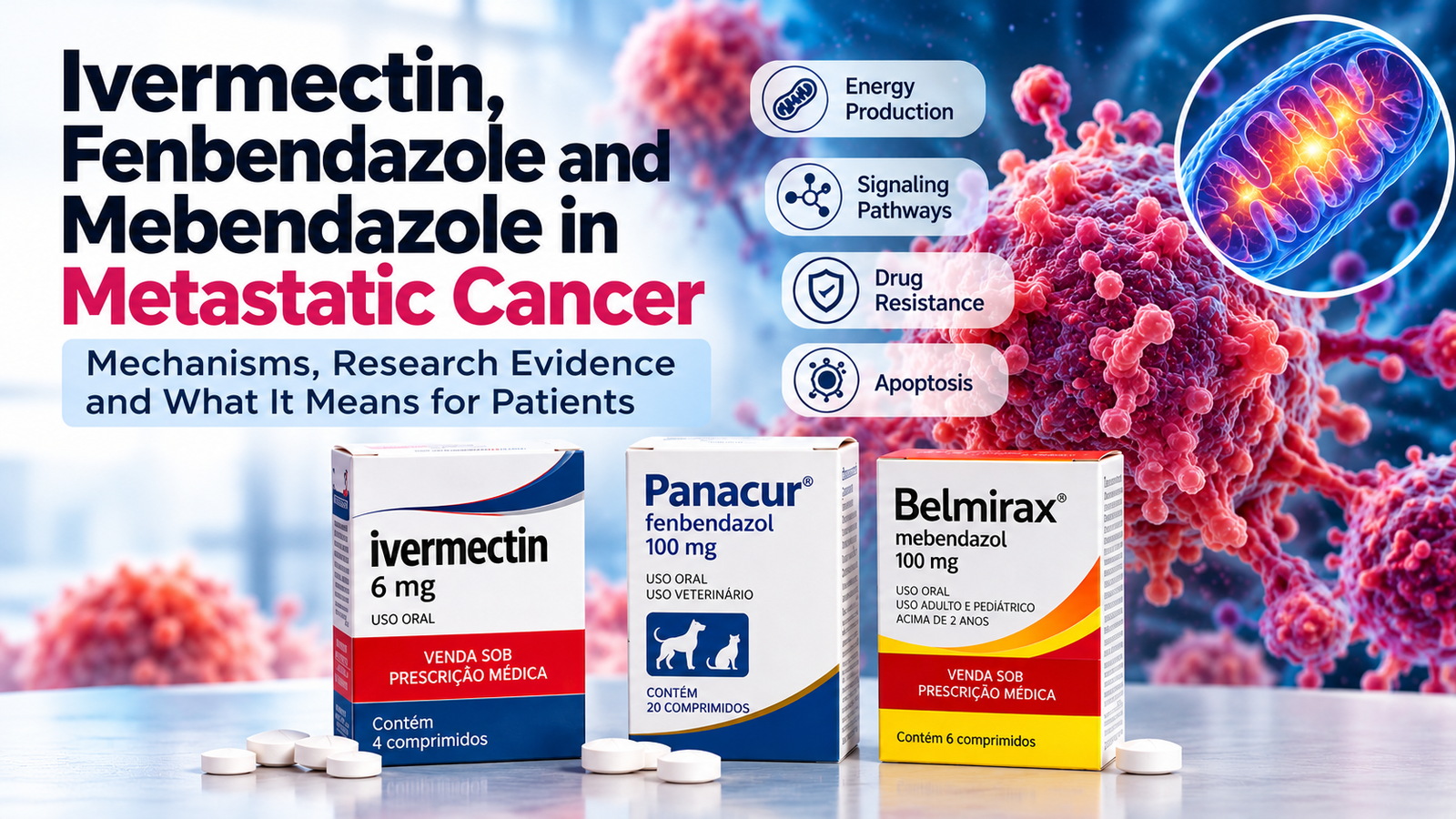
Can ivermectin, fenbendazole or mebendazole treat metastatic cancer? These antiparasitic drugs are discussed in experimental cancer research, but none has been shown through adequate clinical evidence to treat or cure metastatic cancer. This guide explains proposed mechanisms, what clinical research has tested and important safety limitations.
Evidence note: This is an educational research overview, not a treatment protocol.
What Is Metastatic Cancer?
Metastatic cancer is cancer that has spread from its original site to distant tissues or organs. The new tumors contain cells from the original cancer. Cancer cells depend on metabolism, growth signals, blood supply and mechanisms that evade cell death. These biological systems are important research targets, but a drug affecting them in a dish may not help a patient.
Why Are Antiparasitic Medicines Being Investigated?
Drug repurposing explores whether existing medicines may have additional uses. Ivermectin and mebendazole are used for certain human parasitic infections, while fenbendazole is primarily a veterinary medicine. Scientists have tested them in cell cultures and animal models. A laboratory observation is a starting hypothesis—not evidence that a medicine treats metastatic cancer.
Ivermectin and Mitochondrial Energy
Mitochondria help cells produce ATP. In certain preclinical tumor models, investigators have examined whether ivermectin changes mitochondrial activity, reactive oxygen species or oxidative stress. These effects vary by model and concentration. A major unresolved question is whether relevant concentrations can be reached safely in human tumors.
Cell Signaling: AKT/mTOR, WNT and Autophagy
The PI3K/AKT/mTOR and WNT/β-catenin networks influence cell growth, survival and differentiation. Autophagy recycles cellular components and can support or constrain tumor cells depending on context. Experiments have investigated whether ivermectin changes these pathways. Such pathway changes are not clinical proof of tumor control.
Apoptosis: The Cell’s Programmed Death Process
Apoptosis is a regulated process that removes unwanted or damaged cells. Mitochondrial proteins and caspases participate in some forms of apoptosis. Certain laboratory studies report apoptosis-related changes following exposure to ivermectin. That finding alone does not demonstrate cancer regression, survival benefit or safe treatment in humans.
Drug Resistance and P-glycoprotein
P-glycoprotein (P-gp) can export some drugs from cells, contributing to resistance in certain settings. Preclinical researchers have investigated ivermectin and drug transport pathways. This does not mean ivermectin can safely reverse chemotherapy resistance; combining drugs may alter exposure and toxicity.
Fenbendazole: Microtubules and the Limits of the Evidence
Fenbendazole belongs to the benzimidazole family. Microtubules are involved in cellular structure and division, making them a potential research target. For formulation and veterinary antiparasitic product information, see Fenbendazole 444 mg tablets. This product is not an approved human cancer treatment. Fenbendazole is not approved for human cancer treatment and has no established anticancer dose or clinical benefit in people. Veterinary products must not be substituted for human medicines. Read fenbendazole safety and liver concerns and fenbendazole lung cancer research.
Mebendazole: Why Human Clinical Trials Matter
Mebendazole is a human antiparasitic drug that has been studied in early oncology trials, including high-grade glioma and pediatric brain tumor settings. Researchers have explored microtubule disruption, cell proliferation and tumor biology. Early studies may evaluate tolerability or feasibility, but they do not establish that mebendazole treats metastatic cancer. See mebendazole versus fenbendazole research and mebendazole and gefitinib research.
Comparison of the Three Medicines
| Medicine | Established use | Research focus | Cancer evidence |
|---|---|---|---|
| Ivermectin | Certain human parasitic infections | Metabolism, signaling, apoptosis and transporters | No established clinical anticancer benefit |
| Fenbendazole | Veterinary parasite treatment | Microtubules and cell proliferation | No established human anticancer benefit |
| Mebendazole | Certain human intestinal worm infections | Microtubules and tumor biology | Early clinical research; efficacy unproven |
Can Ivermectin, Fenbendazole and Mebendazole Be Combined?
There is no validated three-drug protocol for metastatic cancer. Combining medicines without medical supervision can create unpredictable interactions and adverse effects, including liver-related concerns. Our overview of online antiparasitic protocol claims provides additional context, but online regimens are not substitutes for evidence-based oncology care.
Why Laboratory Success May Fail in Patients
Cancer cell experiments may use concentrations that cannot be achieved safely in people. Human absorption, metabolism, tissue penetration, drug interactions and tumor heterogeneity can change the results. Clinical trials are needed to evaluate safety and meaningful outcomes, including tumor response, survival and quality of life.
What Should Patients Do?
People with metastatic cancer should discuss emerging therapies and clinical trial eligibility with their oncology team. Do not stop prescribed chemotherapy, immunotherapy, targeted therapy or other cancer treatment to self-administer antiparasitic medicines. The National Cancer Institute clinical trials guide explains how trials work.
Research References
- ClinicalTrials.gov: mebendazole in high-grade glioma
- ClinicalTrials.gov: mebendazole in pediatric brain tumors
- National Cancer Institute: clinical trials
Frequently Asked Questions
Can ivermectin cure stage 4 cancer?
No reliable human clinical evidence establishes that ivermectin cures metastatic cancer.
Is fenbendazole approved for human cancer treatment?
No. It is primarily a veterinary medicine and is not approved for human cancer treatment.
Is mebendazole being studied for cancer?
Yes. Early clinical trials have evaluated it in certain brain tumor settings, but anticancer efficacy remains unproven.
Can these medicines reverse chemotherapy resistance?
Some experimental studies explore drug transport pathways, but there is no established clinical benefit.
Do they starve cancer cells?
Some laboratory experiments examine metabolism, but the phrase oversimplifies biology and does not establish effectiveness.
Is there an approved cancer dose?
No validated anticancer dose or treatment schedule exists for these medicines.
Can the three medicines be taken together?
No validated cancer regimen establishes the safety or effectiveness of this combination.
Should patients stop chemotherapy to try them?
No. Discuss treatment questions and clinical trials with a qualified oncologist.
Can veterinary fenbendazole be used by people?
Veterinary formulations are not approved for human use and should not be self-administered.
Where can patients find cancer clinical trials?
Search ClinicalTrials.gov and consult an oncology team about eligibility.
Final Thoughts
Repurposed-drug research can generate useful scientific hypotheses, but laboratory mechanisms are not proof of clinical effectiveness. Cancer treatment decisions should be guided by an oncology team and reliable human evidence.
Medical disclaimer: This content is informational only and is not medical advice. It does not recommend off-label self-treatment, veterinary medicines or replacing standard cancer therapy.