Ivermectin dosage chart for humans

Human Ivermectin Dosing Reference Manual: Weight-Based Charts & Product Formulations
Critical Medical & Safety Notice
Ivermectin is a potent, prescription-only antiparasitic drug. Human dosing must be strictly calculated based on exact body weight and the specific type of parasitic infection being targeted. Never consume veterinary-grade ivermectin formulations, as they contain highly concentrated doses and industrial excipients dangerous to human physiology. This guide is for educational purposes and does not replace professional clinical calculation.
Few medications in modern history have had as profound a global impact on public health as Ivermectin. Discovered in the late 1970s and earning a Nobel Prize in Physiology or Medicine in 2015, this macrocyclic lactone revolutionized the treatment of debilitating parasitic diseases worldwide. Today, standard oral human ivermectin regimens are foundational tools for eliminating complex internal and external parasitic infestations.
Unlike many common pharmaceutical compounds that rely on standardized, one-size-fits-all dosing models, human Ivermectin administration is deeply individualized. Because the drug targets parasites within specific tissues based on systemic concentration thresholds, safety and efficacy rely entirely on a precise weight-based calculation. Taking too little leads to treatment failure and drug resistance; taking too much places unnecessary stress on metabolic clearance pathways.
Whether you are managing an intestinal worm infection or addressing a severe ectoparasitic infestation, understanding how clinical practitioners calculate these guidelines is essential. This clinical guide provides an in-depth breakdown of the official, evidence-based human dosage protocols, detailed weight matching charts, metabolic pathways, and structural safety rules across various available oral and topical variants.
Approved Clinical Indications & Available Formulations
To understand human dosing charts, one must first recognize the underlying conditions Ivermectin is scientifically engineered to eliminate. The drug functions as a broad-spectrum antiparasitic agent, working through specific pathways that differ markedly between internal helminths (worms) and external arthropods (mites). Product references: Iverheal 3 Mg, Iverheal 6 Mg, Iverheal 12 Mg, Ivermectin 24 Mg, and Ivermectin 40 Mg. Browse the Ivermectin category for the complete range.
The two primary global indications approved by major regulatory bodies are Strongyloidiasis (intestinal threadworm) and Onchocerciasis (river blindness). Additionally, physicians frequently prescribe oral and topical variants off-label to manage severe cases of Scabies and dermatological rosacea outbreaks.
To accommodate different body sizes and conditions, global pharmaceutical manufacturers provide a range of dosing concentrations. For lower or standard weight brackets, lower-strength variants such as Iverheal 3 Mg – Ivermectin and Iverheal 6 Mg – Ivermectin are ideal for incremental calculations. For typical adult weight brackets, the standard single-pill strength of Iverheal 12 mg – Ivermectin is highly utilized. For high-dose medical treatments or intensive therapeutic plans, clinicians rely on high-potency options like Ivermectin Tablets 24mg or the heavy-duty Ivermectin Tablets 40mg variants.
The Mechanism of Action: Why Weight-Based Dosing is Essential
Ivermectin works by selectively binding to glutamate-gated chloride ion channels, which are highly prevalent in invertebrate nerve and muscle cells. This binding causes an influx of chloride ions, hyperpolarizing the parasite’s cells. The result is rapid, flaccid paralysis of the parasite’s pharyngeal pump and neuromuscular system, leading to its death or expulsion from the human host.
In humans, these specific ion channels are safely protected behind the blood-brain barrier. Under normal conditions and at standard therapeutic concentrations, the drug cannot cross this barrier, making it exceptionally safe for human use. However, if a patient consumes an uncalculated megadosage, the drug can overwhelm these protective systems, leading to severe neurotoxicity.
This delicate safety balance is why exact dosing based on milligrams per kilogram of body weight is critical. For an exhaustive breakdown of the official pharmacodynamics, you can review the peer-reviewed NIH NCBI Bookshelf Ivermectin Clinical Summary.
Official Human Ivermectin Dosing Charts
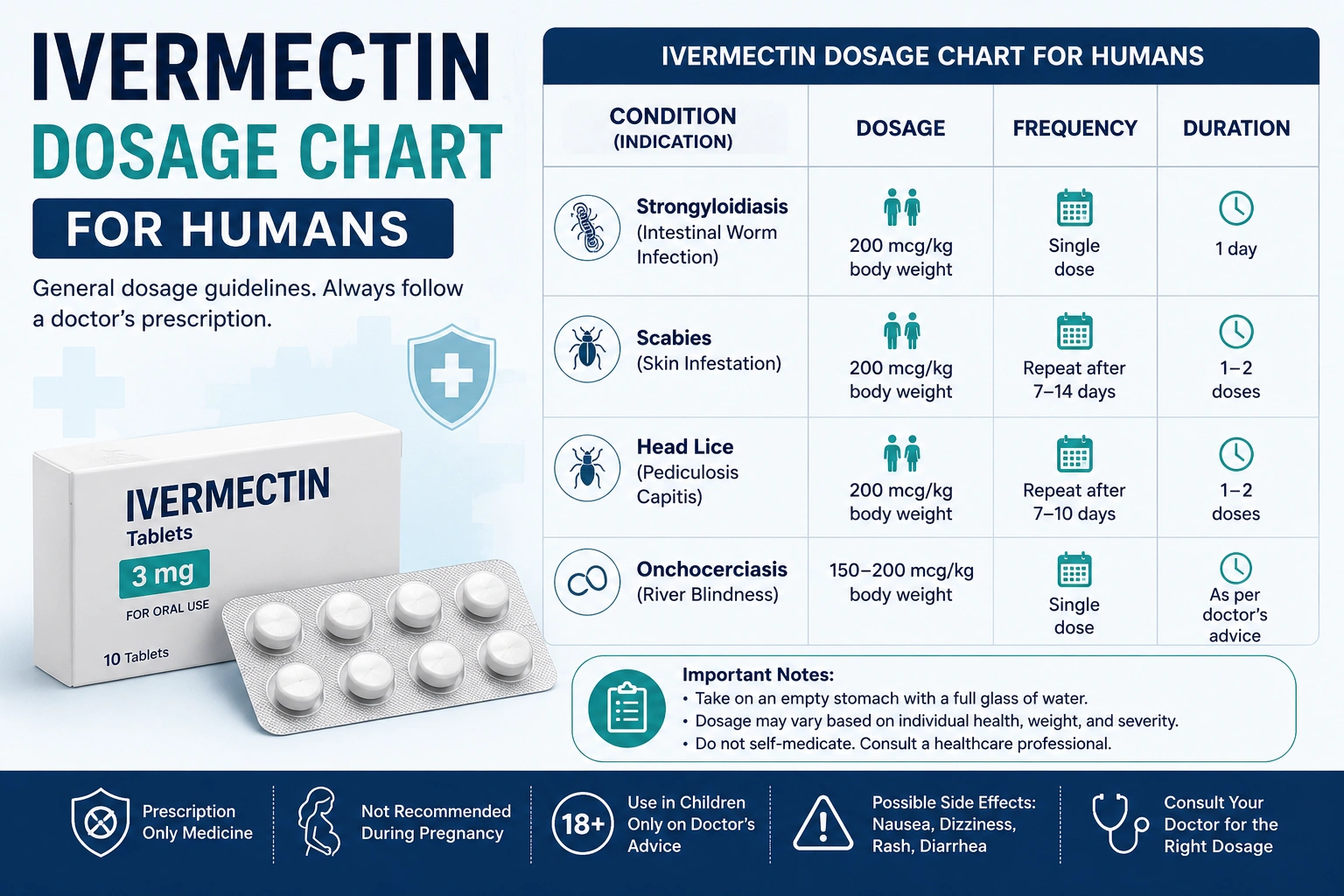
Clinical protocols establish two primary oral dosing levels depending on the type of parasite being treated: 200 mcg/kg for strongyloidiasis and scabies, and 150 mcg/kg for onchocerciasis.
1. Dosing Chart for Intestinal Strongyloidiasis (200 mcg/kg Baseline)
This chart details the typical target dosage required for a single-dose treatment of strongyloidiasis in adults and children weighing 15 kg (33 lbs) or more:
| Patient Weight (kg) | Patient Weight (lbs) | Standard Target Dose | Example Pill Formulation Match |
|---|---|---|---|
| 15 to 24 kg | 33 to 53 lbs | 3 mg total | 1x Iverheal 3 mg tablet |
| 25 to 35 kg | 55 to 77 lbs | 6 mg total | 1x Iverheal 6 mg tablet |
| 36 to 50 kg | 79 to 110 lbs | 9 mg total | 3x Iverheal 3 mg tablets |
| 51 to 65 kg | 112 to 143 lbs | 12 mg total | 1x Iverheal 12 mg tablet |
| 66 to 79 kg | 145 to 174 lbs | 15 mg total | 1x 12 mg + 1x 3 mg tablet |
| 80 kg or more | 176 lbs+ | 24 mg to 40 mg+ | Requires clinical calculation (24mg/40mg lines) |
Topical Alternatives for Dermatological Care
Not every parasite or skin condition requires a systemic, oral approach. For surface-level outbreaks, localized inflammatory skin lesions, and rosacea management, researchers developed topical formulas. Applying medication directly to the face or affected skin delivers the active therapeutic benefits straight to the target area while minimizing systemic exposure in the blood.
A premier option in this category is Ivrea – Ivermectin Cream 1%. This smooth topical formulation is specifically engineered for skin use, acting directly against localized microscopic skin mites (such as *Demodex* mites) that cause facial redness and papules. Unlike oral pills, this cream does not follow weight-based internal charts; instead, it is applied as a thin film over the affected areas once a day, following a doctor’s instructions.
Best Practices for Taking Oral Ivermectin
Achieving maximum treatment success depends heavily on how you take the medication. The chemical structure of Ivermectin interacts significantly with your digestive environment:
Essential Administration Rules
1. Take on an Empty Stomach: For treating standard internal parasitic infections, always take your tablets with a full glass of water at least 1 hour before a meal or 2 hours afterward. Food increases the systemic absorption of the drug, which can divert the active ingredients away from the gut where the parasites reside.
2. The High-Fat Exception: In specific cases where widespread systemic absorption is required—such as severe, crusted scabies—your physician may advise taking the dose with a high-fat meal. This step can increase the drug’s bioavailability by up to 2.5 times, but it should only be done under explicit medical instruction.
3. Pediatric Restrictions: Ivermectin is strictly contraindicated for children weighing less than 15 kilograms (33 lbs) or for pregnant individuals, as safety guidelines for these groups have not been established.
Potential Side Effects and Drug Interactions
When used at the appropriate, weight-matched doses, human Ivermectin is generally well-tolerated. Most side effects are not reactions to the drug itself, but rather a response to the dying parasites clearing the body.
Common side effects include mild dizziness, nausea, localized swelling, and transient skin itching. However, if the drug is misdosed, users face severe risks, including dangerous drops in blood pressure (orthostatic hypotension), seizures, liver enzyme spikes, and severe skin reactions like Stevens-Johnson Syndrome.
Additionally, Ivermectin can enhance the anticoagulant effects of blood thinners like Warfarin, leading to an increased risk of internal bleeding. Always provide your doctor with a complete list of your current medications before starting treatment.
Human Ivermectin Dosing Checklist
Ensure a safe and effective treatment process by following these core guidelines:
- ✔️ Weigh In Accurately: Ensure your doctor has an up-to-date, accurate measurement of your body weight.
- ✔️ Follow the Empty Stomach Rule: Take tablets with water 1 hour before or 2 hours after food.
- ✔️ Never Mix with Alcohol: Avoid alcohol during treatment, as it can dangerously amplify the drug’s effects on the central nervous system.
- ✔️ Avoid Veterinary Alternatives: Never consume pastes or liquids designed for horses or livestock.
- ✔️ Verify Medication Origins: Ensure your prescription is filled with regulated human-grade tablets.