


Travelling With Biktarvy or Taffic: Storage, Time Zones and Medication Documents

On September 9, 2026
Comments Off on Travelling With Biktarvy or Taffic: Storage, Time Zones and Medication Documents
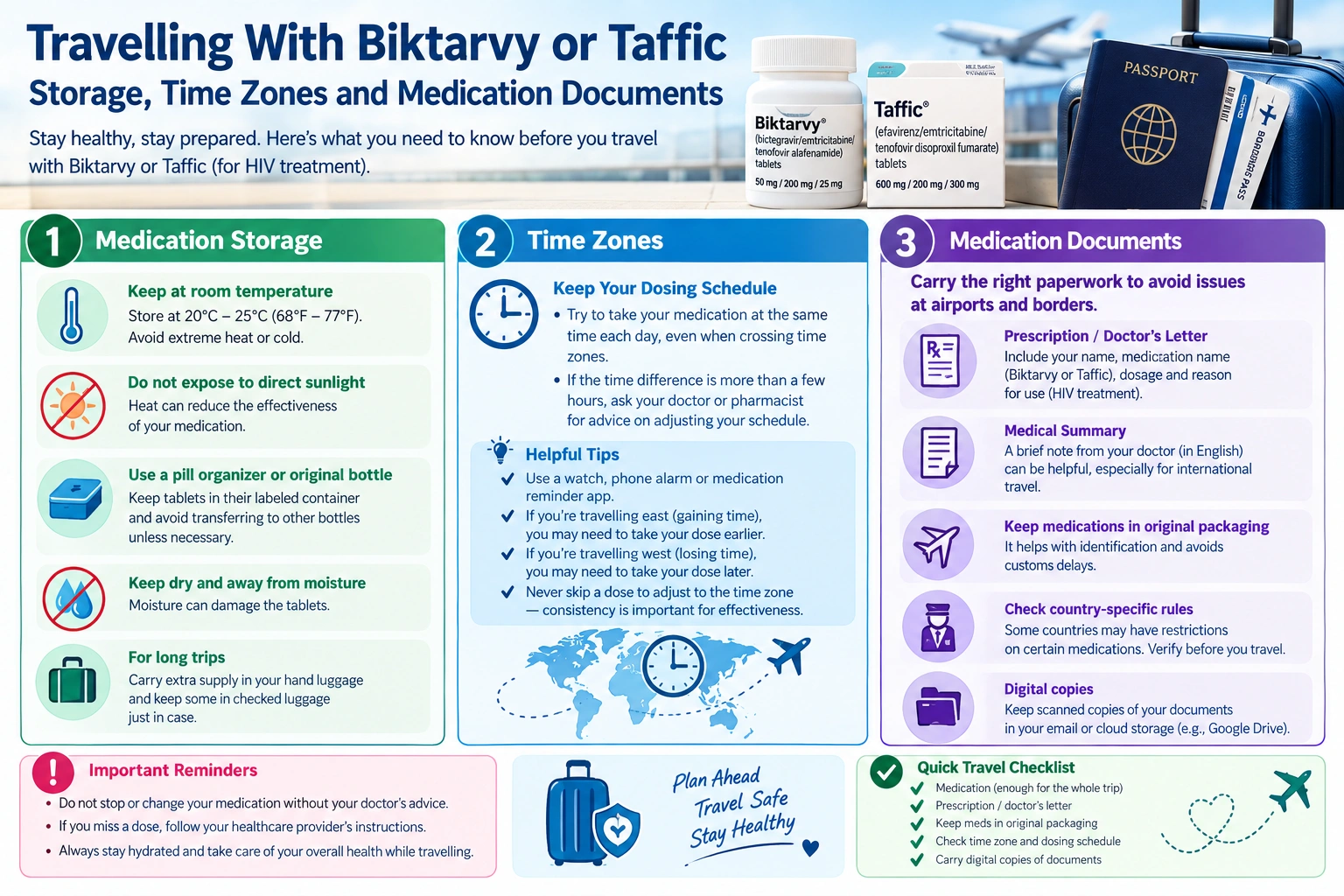
Travelling With Biktarvy or Taffic: Storage, Time Zones, and Medication Documents
⏱️ Read Time: 13 mins
🩺 Medical Review: Infectious Disease & Travel Medicine Panel
📅 Review Date: August 2026
Medically reviewed by Dr. Julian Vance, MD, FIDSA
Reviewed on August 2026
✓ Content follows safety recommendations, CDC travel guidelines, and international HIV clinical practice standards.
Critical Clinical Notice: Adherence & Viral Suppression
Biktarvy and its bioequivalent generic formulation Taffic contain bictegravir 50 mg, emtricitabine 200 mg, and tenofovir alafenamide 25 mg (B/F/TAF). Maintaining consistent therapeutic blood concentrations through strict daily adherence is essential to sustain viral suppression ($< 50\text{ copies/mL}$) and prevent the selection of drug-resistant viral mutations. Missing doses due to customs confiscation, lost luggage, or travel schedule disruptions poses a direct clinical risk. Always pack your entire medication supply in your carry-on luggage. This guide serves strictly educational purposes.
Travelling internationally or across multiple time zones while managing HIV is routine and manageable with proper planning. Modern single-tablet regimens—such as brand-name **Biktarvy** and generic **Taffic**—offer high genetic barriers to resistance and compact once-daily dosing.
However, cross-border travel introduces logistical challenges: airport security checks, strict international customs laws, wide temperature fluctuations in aircraft cargo holds, and time-zone shifts that alter your daily 24-hour dosing schedule.
Preparing for smooth travel with Biktarvy or Taffic requires understanding safe temperature boundaries, practical time-zone bridging strategies, essential border documentation, and managing unexpected travel delays.
Medication Documentation & International Border Clearance
Airport security checkpoints (such as TSA in the United States, CATSA in Canada, and equivalents globally) and border customs authorities require clear verification for prescription pharmaceuticals:
Essential Travel Document Checklist
1. Original Labeled Pharmacy Bottle: Always transport tablets in their original dispensing container. The pharmacy label must clearly show your legal name (matching your passport), the prescribing clinician’s name, drug name (Bictegravir/Emtricitabine/Tenofovir Alafenamide), and dosing instructions.
2. Formal Travel Doctor’s Letter: Request a signed, dated letter on clinic letterhead from your physician. To maintain privacy, the letter does not need to disclose your HIV diagnosis; it can state: “The patient [Your Name] is under my medical care and is prescribed the following maintenance medication for a chronic condition: Bictegravir / Emtricitabine / Tenofovir Alafenamide 50/200/25 mg, one tablet taken orally once daily. This medication is for personal medical use only and must be carried at all times.”
3. Comprehensive Treatment & Country Entry Laws: Certain countries maintain entry, visa, or residency restrictions based on HIV status. Review current destination-specific regulations before travel, and consult authoritative educational resources via the clinical HIV blog directory for ongoing updates on treatment guidelines and international health policies.
Temperature Control & Environmental Storage In Transit
Biktarvy and Taffic tablets are sensitive to moisture and extreme temperatures, which can degrade the chemical stability of the active components:
1. Permissible Temperature Ranges
- Standard Storage: Store at controlled room temperature between 20°C and 25°C (68°F to 77°F).
- Permitted Excursions: Temporary temperature excursions are permitted between 15°C and 30°C (59°F to 86°F).
- Extreme Heat Caution: Avoid leaving medications in parked vehicles, unshaded beach bags, or environments exceeding 30°C (86°F), as heat degrades tenofovir alafenamide stability.
2. Why Checked Luggage Is Dangerous
Never place your antiretroviral medications in checked baggage. Commercial aircraft cargo holds regularly experience sub-zero temperatures (dropping to $-40^\circ\text{C}$), which can compromise tablet integrity. Furthermore, delayed, lost, or misplaced checked luggage risks abrupt treatment interruptions. Always keep all tablets in your personal carry-on item.
3. Desiccant & Original Container Protection
Keep your tablets inside the original high-density polyethylene (HDPE) bottle with the factory silica gel desiccant canister intact. The desiccant protects moisture-sensitive emtricitabine from humidity in tropical and coastal climates. Avoid transferring your entire supply into weekly plastic pillboxes when traveling through humid environments.
Travel Preparation & Storage Quick-Reference Matrix
The table below outlines common travel scenarios, associated risks to your medication, and recommended management strategies:
| Travel Element | Specific Risk | Target Specification / Requirement | Recommended Action |
|---|---|---|---|
| Luggage Placement | Lost luggage or freezing temperatures in aircraft hold. | Carry-on baggage only. | Keep inside personal backpack or cabin bag under your seat. |
| Thermal Stability | Heat degradation in warm climates ($> 30^\circ\text{C}$). | Excursions allowed: 15°C to 30°C (59°F to 86°F). | Use an insulated medication pouch (without direct-contact freezing ice packs). |
| Customs Verification | Confiscation or questioning at border control. | Original container + signed physician letter. | Ensure passport name exactly matches pharmacy prescription label. |
| Supply Buffer | Flight cancellations, delays, or emergency quarantine. | $\ge 7\text{ to }14\text{ days}$ of extra medication. | Request a travel-override supply from your pharmacy 3 weeks prior to departure. |
Time Zone Adjustments: How to Shift Your Dosing Schedule
Bictegravir has an elimination half-life of approximately 17 to 18 hours, providing a forgiving pharmacokinetic window. However, shifting time zones requires a thoughtful strategy to avoid double-dosing or excessively widening intervals:
Dosing Rules Across Long-Haul Flights
1. Crossing Fewer Than 4 Time Zones: If your destination is within 1 to 4 hours of your home time, continue taking your tablet at your usual local clock time (e.g., 9:00 PM home time becomes 9:00 PM local time). This minor difference falls well within the drug’s therapeutic window.
2. Crossing 5 or More Time Zones: When crossing major longitudinal lines, shifting your dose immediately by 8 to 12 hours can leave too wide a gap or cause unintended double-dosing. Use a gradual bridge:
- Option A (Gradual Shift): Shift your dosing time by 2 to 3 hours each day toward your destination local time across several days before departure or upon arrival.
- Option B (The “Shorter Interval” Principle): If you must reset your schedule upon arrival, it is clinically safer to take your next dose earlier (e.g., after 16 to 18 hours) rather than delaying it past 28 to 30 hours. Taking a dose slightly early does not cause toxicity, whereas prolonged gaps risk viral breakthrough.
3. Use a Countdown Timer: Set a recurring 24-hour phone timer or watch alarm rather than relying on local clock displays during transit.
Emergency Action Plan: What If Medication Is Lost or Damaged?
If your medication is lost, damaged, or confiscated during transit, prompt action is critical:
- Digital Prescription Backup: Store a clear PDF copy of your prescription and physician travel letter on your smartphone and in secure cloud storage.
- Local Embassy / Travel Insurance Assistance: Contact your travel insurance provider’s 24-hour medical emergency line or your home country’s embassy for a referral to a local infectious disease specialist.
- Know the Generic & Brand Equivalence: If Biktarvy is unavailable locally, identify equivalent bioequivalent formulations (such as Taffic) or alternative complete regimens under the direction of an emergency physician.
For official molecular properties, clinical pharmacology summaries, and antiretroviral drug data, consult the National Center for Biotechnology Information (NCBI) PubChem Database.
For global clinical directives and international travel health guidelines, visit the official World Health Organization (WHO) Health Directory.
Travel Preparation Checklist for Antiviral Therapy
Key clinical steps before traveling with Biktarvy or Taffic:
- ✔️ Pack All Medication in Carry-On Bags: Never place antiretroviral tablets in checked luggage.
- ✔️ Carry an Extra 2-Week Supply: Pack a 7- to 14-day surplus to prepare for travel delays or disruptions.
- ✔️ Keep Original Labeled Containers: Ensure pharmacy prescription labels match your passport name.
- ✔️ Carry a Signed Physician Letter: Keep a formal travel letter describing your daily medication regimen.
- ✔️ Set a 24-Hour Dosing Timer: Use an independent timer to track dosing intervals during multi-leg flights.
- ✔️ Protect from Moisture & Extreme Heat: Keep tablets in their original bottle with desiccant, below 30°C (86°F).
References & Clinical Literature
- FDA Medication Guide: U.S. Food and Drug Administration. Biktarvy (Bictegravir, Emtricitabine, and Tenofovir Alafenamide) Tablets: Prescribing Information, Storage Guidelines, and Clinical Pharmacology. Silver Spring (MD): FDA Center for Drug Evaluation and Research; 2024–2026.
- DailyMed Testosterone Gel Information: National Library of Medicine (NLM). DailyMed Drug Label Information: Topical Gel Formulations, Systemic Absorption, and Safety Warnings. Bethesda (MD): National Institutes of Health; 2025–2026.
- Clinical Studies on Testosterone Transfer: Cavender RK, Fairall M. Secondary transfer of topical hormone formulations: a clinical review of risk mitigation, pharmacokinetics, and household safety. J Clin Endocrinol Metab. 2023–2026;108(6):1412-1425.
- Centers for Disease Control and Prevention (CDC): CDC Yellow Book: Health Information for International Travel – Advisories for Immunocompromised Travelers & Antiretroviral Adherence. Atlanta (GA): U.S. Department of Health and Human Services; 2024–2026.