


How Long Does Flibanserin (Addyi) Take to Work? Results, Effectiveness and Safety

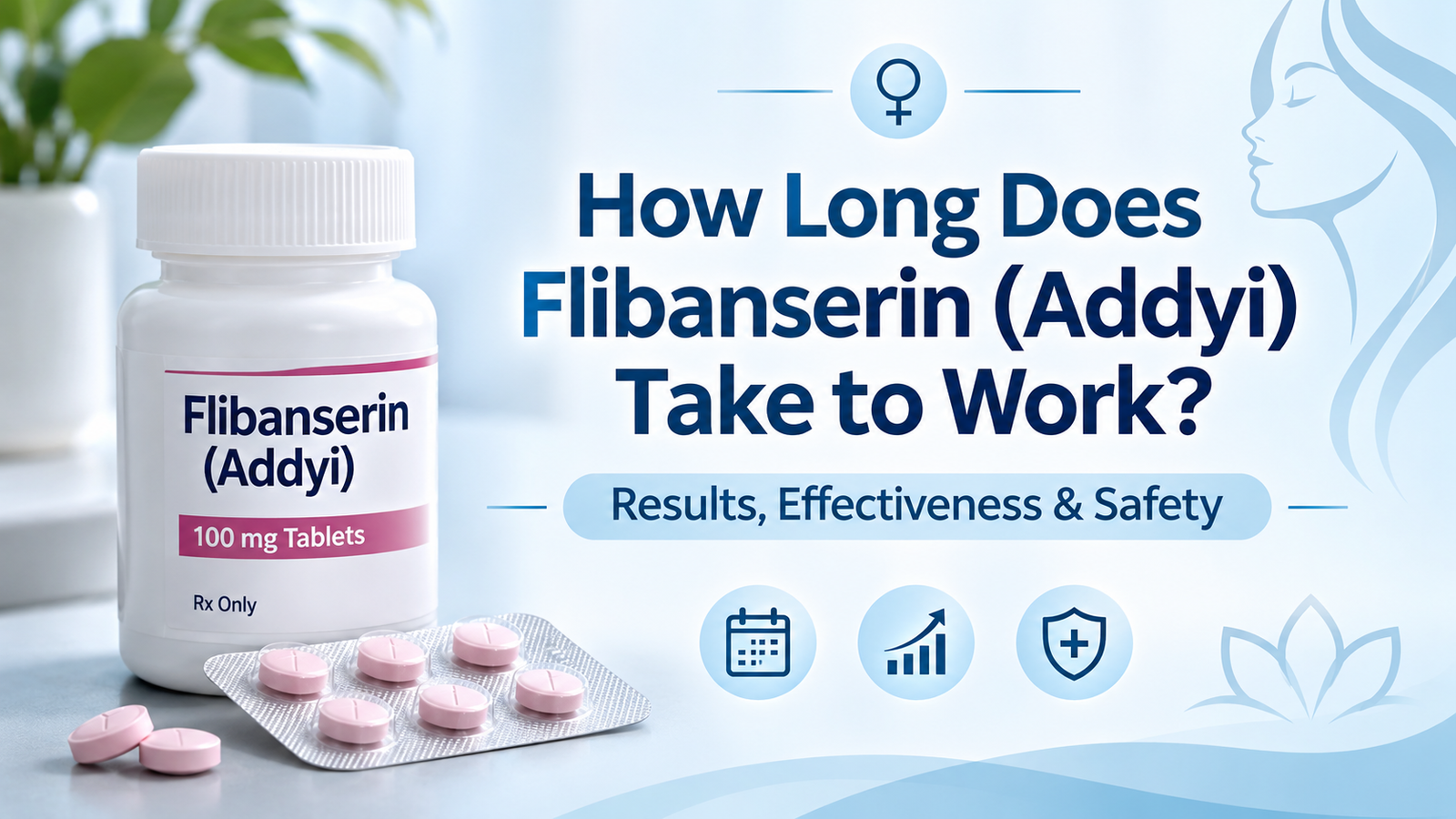
How long does flibanserin take to work? Flibanserin, marketed in the United States as Addyi, is taken daily for acquired, generalized hypoactive sexual desire disorder (HSDD) in eligible women younger than 65. It is not an on-demand sexual-performance drug. There is no guaranteed response timeline: improvement is assessed over several weeks, and the US prescribing information recommends stopping after eight weeks if there is no improvement.
What is flibanserin and who may benefit?
Flibanserin is prescribed for acquired, generalized HSDD: low desire that developed after previously normal sexual desire, occurs across situations, and causes marked distress or interpersonal difficulty. A healthcare professional must exclude other explanations, including medical or psychiatric conditions, relationship problems, and effects of medicines or substances. Not every experience of low desire is HSDD, and a prescription is not appropriate solely because someone wants an increase in sexual performance.
For the ingredient, strength, precautions and pack options, see the Flibanserin 100 mg tablets product page. Pinkline Exports’ separately sourced generic listing is not the US-branded Addyi product; the FDA’s approval of Addyi does not imply approval or equivalence of another manufacturer’s product.
How long does flibanserin take to work?
It is taken once a day at bedtime, not right before sexual activity. Changes, if any, may be gradual and vary between people. Patients and prescribers should look at meaningful changes in desire and the distress associated with low desire, instead of expecting an immediate effect after one dose.
Weeks 1–4: establishing baseline and monitoring safety
During the early treatment period, a patient may track whether low desire continues to be distressing and whether dizziness, nausea, tiredness or sleepiness occurs. An absence of obvious improvement in the first few days does not necessarily predict the eventual response. Do not change the prescribed dose in response to early results.
Weeks 5–8: reviewing whether treatment helps
Discuss any perceived changes with the prescribing clinician. The US label instructs patients to discontinue Addyi after eight weeks if there is no improvement. That is a clinical reassessment point, not a promise that the medicine will work by the eighth week.
What counts as improvement with Addyi?
Studies of flibanserin assessed sexual desire, distress about low desire and the frequency of satisfying sexual events. Benefits seen across study groups were modest on average and cannot predict the outcome for an individual. Some patients may find a meaningful improvement, while others will not benefit enough to justify continuing.
A useful patient–clinician review considers: whether distress has changed; whether desire has changed in a way that matters to the patient; whether adverse effects interfere with daily life; and whether an alternative cause of symptoms should be addressed.
See also the site’s earlier overview, Benefits of Addyi (Flibanserin) USA. This guide focuses specifically on the treatment timeline and assessing a response rather than repeating the general benefits article.
Why is flibanserin taken at bedtime?
Flibanserin affects central serotonin signaling, including 5-HT1A and 5-HT2A receptors. The US labeled dose is 100 mg once daily at bedtime. Bedtime administration reduces risks associated with daytime dosing, including low blood pressure, fainting, drowsiness and accidental injury. It is not an immediate blood-flow treatment like sildenafil, and the two medicines are not interchangeable.
What happens if flibanserin has not worked after eight weeks?
Do not increase the dose or double tablets. The prescribing clinician should discontinue treatment if there is no improvement and consider reassessing the diagnosis, medication side effects, psychological stress, pain, hormonal or other medical concerns, and relationship factors. Other interventions may be more suitable depending on the cause.
Side effects and safety precautions
Commonly reported adverse effects include dizziness, sleepiness, nausea, fatigue, insomnia and dry mouth. More serious concerns include hypotension (low blood pressure) and syncope (fainting). Moderate or strong CYP3A4 inhibitors and liver impairment are contraindications. Medicines and supplements must be reviewed by a qualified prescriber.
Can alcohol be taken with flibanserin?
Alcohol too close in time to a flibanserin dose increases the risk of severe low blood pressure and fainting. The current US Addyi instructions say to wait at least two hours after one or two standard alcoholic drinks before taking the bedtime dose, or skip that dose if three or more drinks were consumed that evening. Avoid alcohol until at least the following day after taking the dose, as specified in the full medication guide. These timing precautions do not eliminate all risk; follow your prescriber’s instructions.
What if a dose is missed?
Under the US label, skip a missed bedtime dose and resume at the usual bedtime the next day. Do not take a double dose. Avoid driving or hazardous tasks for at least six hours after a dose and until fully alert.
Frequently asked questions
Does Addyi work immediately?
No. It is a daily treatment. Its effect, if any, is assessed over weeks rather than immediately before sexual activity.
Does everyone experience improvement within eight weeks?
No. Some patients do not improve. The label recommends discontinuation when no improvement has occurred after eight weeks.
Can flibanserin treat low desire after menopause?
The US label was updated in December 2025 to include eligible women younger than 65, including postmenopausal women in that age range. Suitability still depends on a formal diagnosis and an individualized safety assessment.
Is flibanserin the same as female Viagra?
No. The expression is misleading: flibanserin and sildenafil have different indications, mechanisms and dosing schedules.
Is it safe to take two tablets if one is not effective?
No. Do not increase the prescribed dose or double up after a missed tablet. Discuss inadequate response with the prescriber.
Medical sources and review
Primary reference: US FDA Addyi prescribing information (revised December 2025). See also DailyMed’s current Addyi label. Last content review: 4 November 2026. This article has not been represented as individually physician-reviewed.
Medical disclaimer
This article is educational and does not replace professional diagnosis, medical advice or prescribing instructions. Flibanserin is a prescription medicine and may cause dangerous interactions. Seek urgent medical care for fainting, severe dizziness, or other serious symptoms. Medicine availability and legal import requirements vary by location.