


Azelaic Acid for Post-Acne Marks: How It Helps With Dark Spots After Pimples

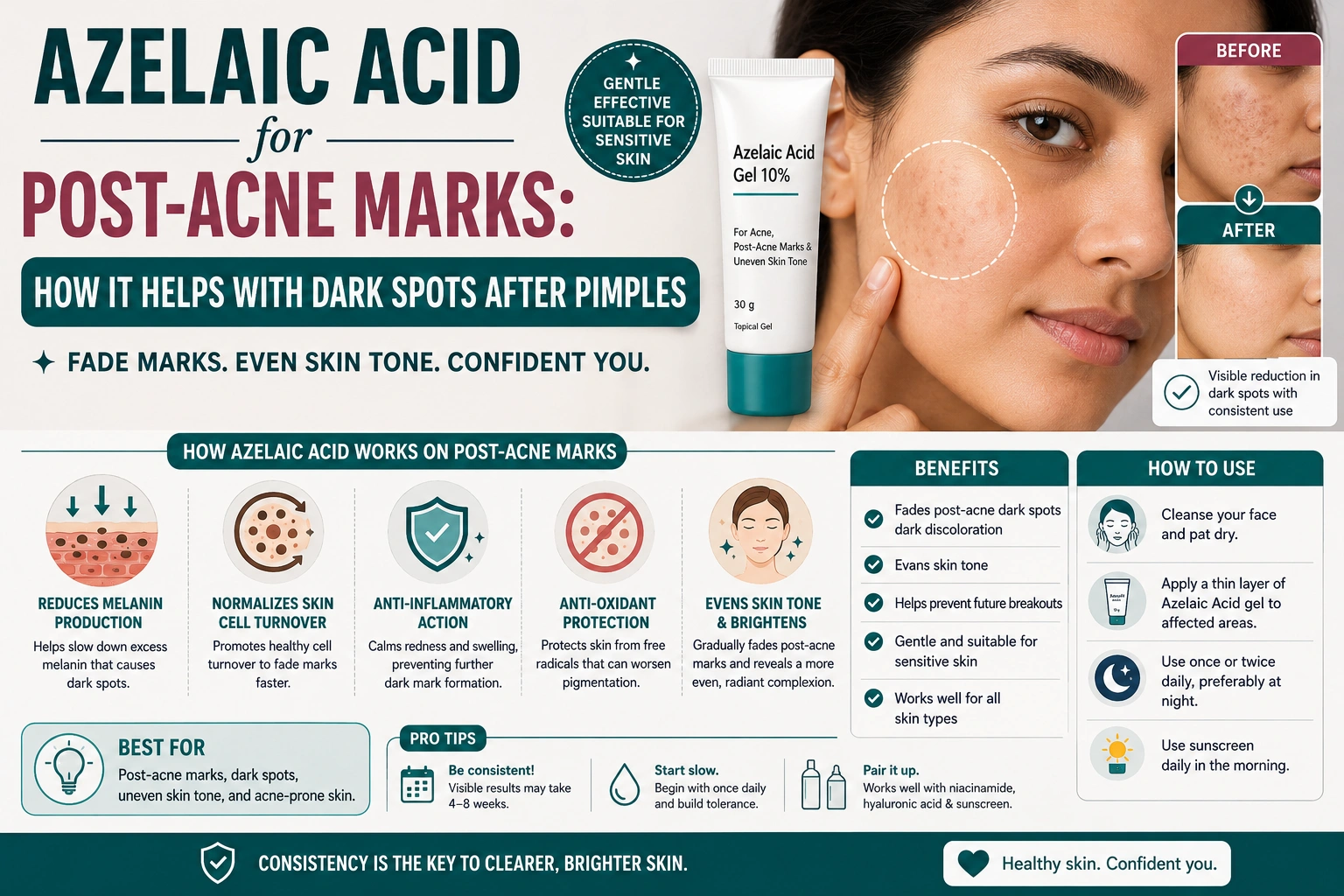
Azelaic Acid for Post-Acne Marks: How It Helps With Dark Spots After Pimples
Medically reviewed by Dr. Julian Vance, MD, FAAD
Reviewed on August 2026
✓ Content follows safety recommendations and evidence-based dermatological clinical practice guidelines.
Critical Clinical Notice: PIH vs. PIE
Post-acne marks fall into two distinct dermatological categories: Post-Inflammatory Hyperpigmentation (PIH) (brown or black excess melanin deposits) and Post-Inflammatory Erythema (PIE) (pink, red, or purplish vascular damage). Azelaic acid effectively targets both pathways through dual tyrosinase inhibition and anti-inflammatory action. However, high concentrations can cause transient tingling, dryness, or peeling. A broad-spectrum sunscreen is essential during treatment to prevent UV-induced repigmentation. This guide serves strictly educational purposes.
Once an active inflammatory acne lesion resolves, it frequently leaves behind persistent discoloration that can linger for months or even years. These marks—collectively referred to as post-acne marks—are not true structural scars (such as icepick or boxcar indentations), but rather localized pigmentary and vascular shifts triggered by inflammatory tissue cascades.
Among evidence-based topical dermatological agents, **Azelaic Acid** (a naturally occurring saturated dicarboxylic acid) is widely recognized for its unique ability to fade stubborn post-acne marks while simultaneously treating active acne breakouts and calming cutaneous redness.
Understanding how Azelaic Acid clears post-acne marks requires exploring the biological differences between PIH and PIE, its selective inhibitory mechanism on hyperactive melanocytes, clinical strength selection, application layering rules, and safety boundaries.
PIH vs. PIE: How Azelaic Acid Addresses Both
To understand how Azelaic Acid fades post-breakout marks, it helps to distinguish the two physiological mechanisms that create them:
Dual Mechanism: Pigment Clearance & Vascular Calming
1. Selective Tyrosinase Inhibition (Clearing PIH): In Post-Inflammatory Hyperpigmentation, inflammatory cytokines trigger epidermal melanocytes to overproduce melanin. Azelaic Acid acts as a competitive inhibitor of tyrosinase, the rate-limiting enzyme in melanin biosynthesis. Crucially, it exhibits selective cytotoxicity toward hyperactive and abnormal melanocytes while having virtually no lightening effect on surrounding normal skin cells.
2. Anti-Inflammatory & Radical Scavenging (Resolving PIE): In Post-Inflammatory Erythema, microscopic capillary dilation and endothelial breakdown produce red or purple spots. Azelaic Acid downregulates pro-inflammatory cytokines (such as IL-1$\beta$, IL-6, and TNF-$\alpha$) and neutralizes reactive oxygen species (ROS), accelerating the resolution of vascular erythema.
3. Gentle Keratolytic Renewal: Azelaic Acid normalizes follicular keratinization, encouraging gentle epidermal cell turnover that helps shed accumulated melanin deposits without aggressively compromising the skin barrier.
In clinical dermatology, high-potency formulations—such as Aziderm 20% Cream 15gm—are prescribed to provide concentrated, medical-grade tyrosinase inhibition for stubborn post-inflammatory discoloration and persistent comedonal/inflammatory acne.
Strength and formulation matter: A concentration listed for azelaic acid does not automatically mean different products are equivalent, as cream versus gel vehicles affect use and tolerance. Treatment of post-inflammatory hyperpigmentation takes time and must include sun protection. Read recurrent acne causes and retinoid strength considerations before combining irritating treatments.
Choosing the Right Concentration: 10% vs. 15% vs. 20%
Azelaic Acid is available across multiple strengths, each serving distinct clinical and tolerance profiles:
1. Over-the-Counter Formulations (10%)
Available without a prescription in cosmetic serums and suspensions. Well-tolerated by sensitive skin barriers, but typically requires a longer timeline (12 to 20 weeks) to achieve noticeable fading on moderate-to-severe PIH.
2. Prescription Gel Formulations (15%)
Commonly prescribed for papulopustular rosacea and mild-to-moderate inflammatory acne. The gel vehicle allows rapid penetration, making it effective for both redness reduction and post-inflammatory marks.
3. High-Potency Prescription Cream Formulations (20%)
The gold-standard strength for hyperpigmentation disorders, including melasma and severe post-acne PIH. Clinical comparative trials demonstrate that 20% Azelaic Acid achieves pigment-clearing efficacy comparable to 4% Hydroquinone, but without the associated risks of exogenous ochronosis or permanent depigmentation.
Post-Acne Mark Treatment Comparison Matrix
The table below outlines how Azelaic Acid compares with other common post-acne mark ingredients:
| Active Ingredient | Primary Target | Mechanism of Action | Skin Sensitivity Profile |
|---|---|---|---|
| Azelaic Acid (15% – 20%) | Both PIH & PIE (Brown & Red Marks) | Selective tyrosinase inhibition + downregulates inflammatory cytokines. | High tolerability; suitable for rosacea-prone and deeper skin tones. |
| Hydroquinone (2% – 4%) | PIH Only (Brown Melanin Marks) | Inactivates tyrosinase; cytotoxic to all melanocytes. | High risk of irritation, rebound pigmentation, and ochronosis if overused. |
| Topical Retinoids (Tretinoin) | PIH & Active Acne | Accelerates cellular turnover; disperses melanin granules. | Moderate-to-high initial irritation, peeling, and photosensitivity. |
| Vitamin C (L-Ascorbic Acid) | PIH & Environmental Aging | Antioxidant; reduces dopaquinone to halt melanin synthesis. | Formulation instability; potential irritation at low pH. |
How to Apply Azelaic Acid for Maximum Efficacy
To achieve optimal skin clearance while protecting the epidermal barrier, follow this dermatologist-approved application protocol:
Step-by-Step Application Technique
1. Cleanse Gently: Wash your face with a mild, non-stripping cleanser. Pat skin completely dry (applying active acids to damp skin can increase stinging and irritation).
2. The “Sandwich Technique” for Sensitive Skin: If starting high-potency 20% cream, apply a lightweight moisturizer first, wait 5 minutes, and then apply a pea-sized amount of Azelaic Acid over the entire face or affected areas to buffer against tingling.
3. Frequency Titration: Begin by applying once every other evening for the first 1 to 2 weeks. Once well-tolerated, increase to once daily in the evening, and eventually twice daily (morning and evening) as directed by your clinician.
4. Mandatory Sun Protection: Apply a broad-spectrum SPF 30 or higher sunscreen every morning. UV exposure triggers melanocytes to produce fresh melanin, which directly reverses the pigment-fading benefits of Azelaic Acid.
Potential Side Effects & Clinical Boundaries
Azelaic Acid has a favorable safety profile across all Fitzpatrick skin types (I through VI) due to its selective action on hyperactive melanocytes:
1. Transient Stinging and Pruritus
Mild burning, stinging, or itching during the first 10 to 15 minutes post-application is common during the first 2 weeks. This sensation diminishes as the cutaneous barrier adapts.
2. Safety in Darker Skin Tones
Unlike certain harsh bleaching agents or chemical peels that can cause accidental hypopigmentation (loss of normal skin color) in deeper skin tones (Fitzpatrick types IV–VI), Azelaic Acid’s targeted affinity for abnormal melanocytes makes it exceptionally safe for treating PIH in melanin-rich skin.
3. Pregnancy and Lactation Compatibility
Azelaic Acid is classified as a preferred, low-risk topical agent during pregnancy and breastfeeding, offering an effective alternative when retinoids and oral therapies are contraindicated.
Azelaic Acid Post-Acne Mark Checklist
Key clinical steps to optimize your post-acne mark treatment plan:
- ✔️ Commit to 8–12 Weeks: Cellular pigment clearance takes time; evaluate progress after 2 to 3 months of consistent use.
- ✔️ Apply to Dry Skin: Ensure skin is fully dry before application to minimize initial stinging.
- ✔️ Never Skip Sunscreen: Daily broad-spectrum SPF 30+ is essential to prevent dark marks from darkening further under UV light.
- ✔️ Treat Both Active Acne & Marks: Azelaic Acid works proactively by clearing current breakouts while fading previous post-acne marks.
- ✔️ Buffer If Irritation Occurs: Apply over a gentle moisturizer if you experience persistent dryness or peeling.
Related options: View Aziderm 20% Cream and browse the Hyperpigmentation Treatment category.
References & Clinical Literature
- FDA Medication Guide: U.S. Food and Drug Administration. Azelaic Acid Topical Gel and Cream Formulations: Drug Labeling, Prescribing Information, and Dermatologic Clinical Pharmacology. Rockville (MD): FDA Center for Drug Evaluation and Research; 2024–2026.
- DailyMed Testosterone Gel Information: National Library of Medicine (NLM). DailyMed Drug Label Information: Topical Gel Formulations, Systemic Absorption, and Safety Warnings. Bethesda (MD): National Institutes of Health; 2025–2026.
- Clinical Studies on Testosterone Transfer: Cavender RK, Fairall M. Secondary transfer of topical hormone formulations: a clinical review of risk mitigation, pharmacokinetics, and household safety. J Clin Endocrinol Metab. 2023–2026;108(6):1412-1425.
- American Academy of Dermatology (AAD): Guidelines of Care for the Management of Acne Vulgaris and Post-Inflammatory Hyperpigmentation. J Am Acad Dermatol. 2024–2026;90(5):1004-1022.