


What Is Nifedipine & Lidocaine Cream Used For?

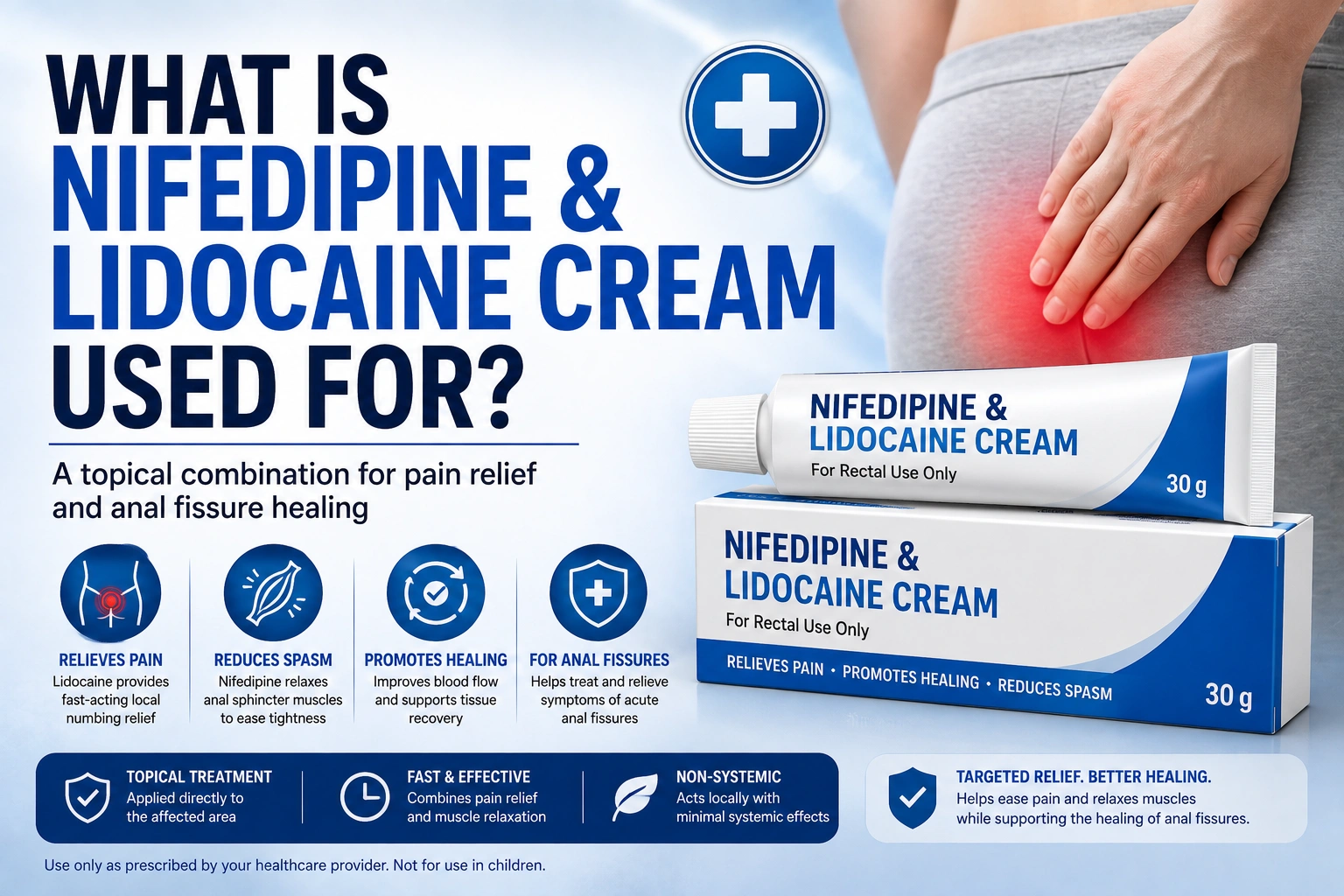
What Is Nifedipine & Lidocaine Cream Used For? Mechanism, Benefits, and Application
Critical Medical & Application Notice
Nifedipine & Lidocaine Cream is a prescription topical formulation primarily indicated for treating acute and chronic anal fissures, as well as painful anorectal conditions. It combines a calcium channel blocker (to relax smooth muscle spasms and improve mucosal blood flow) with a local anesthetic (to provide rapid pain relief). This medication must only be used under the direct guidance of a healthcare provider or proctologist. Proper topical application technique is vital to avoid excessive systemic absorption. This guide serves strictly educational purposes.
Anorectal conditions—such as anal fissures and thrombosed hemorrhoids—can cause severe, sharp pain, burning, and bleeding during and after bowel movements. A major factor that prevents these painful tears or lesions from healing naturally is **anal sphincter hypertonia** (excessive involuntary muscle spasms) coupled with reduced localized blood flow to the anal mucosa.
To address both the underlying muscular hypertonicity and the immediate pain, medical consensus points toward a dual-action topical treatment: combining a calcium channel blocker with a local anesthetic.
Understanding how topical **Nifedipine & Lidocaine Cream** works requires an examination of its dual active ingredients, how it promotes tissue healing, step-by-step application guidelines, and key safety precautions.
Dual Mechanism of Action: Muscle Relaxation + Local Anesthesia
The therapeutic strength of this combined topical cream stems from the complementary actions of its two active pharmaceutical ingredients:
How the Active Ingredients Work Together
1. Nifedipine (Calcium Channel Blocker): Nifedipine works by blocking the influx of calcium ions into the smooth muscle cells of the internal anal sphincter (IAS). This reduces elevated resting muscle tone and relieves sphincter spasms. By relaxing the muscle, it restores microvascular capillary blood flow (perfusion) to the ischemic tear, allowing the tissue to heal.
2. Lidocaine (Local Anesthetic): Lidocaine reversibly blocks voltage-gated sodium channels along nerve fibers in the perianal skin. This halts nerve impulse conduction, providing rapid, localized relief from sharp pain, burning, and itching.
Targeted topical options—such as Nifedipine & Lidocaine Cream—offer a highly effective non-surgical treatment alternative to invasive procedures like lateral internal sphincterotomy (LIS).
Primary Clinical Indications
Nifedipine & Lidocaine Cream is prescribed for specific painful conditions affecting the perianal and anal canal regions:
1. Acute and Chronic Anal Fissures
An anal fissure is a small tear in the lining of the lower anal canal, usually triggered by passing hard or large stools. The resulting pain triggers involuntary spasms of the internal anal sphincter, which restricts blood supply and prevents the tear from closing. Applying topical Nifedipine relaxes the muscle and restores circulation, achieving high healing rates within 2 to 6 weeks.
2. Painful or Thrombosed External Hemorrhoids
Used as an adjunctive short-term therapy to reduce severe localized pain, swelling, and muscle guarding associated with acute thrombosed hemorrhoids or severe perianal inflammation.
3. Post-Operative Proctological Care
Prescribed following certain anorectal surgical procedures (such as hemorrhoidectomy or fissurectomy) to ease painful postoperative bowel movements and manage sphincter spasms.
Clinical Comparison Matrix
The table below outlines the key active components, physiological goals, and expected benefits of Nifedipine & Lidocaine Cream:
| Component | Pharmacological Class | Primary Physiological Action | Clinical Benefit |
|---|---|---|---|
| Nifedipine (0.2% – 0.3%) | Dihydropyridine Calcium Channel Blocker | Relaxes internal anal sphincter smooth muscle; lowers resting sphincter pressure. | Restores microvascular blood flow to the tear, promoting long-term tissue healing. |
| Lidocaine (1.5% – 2.0%) | Amide-Type Local Anesthetic | Blocks nerve impulse propagation along sodium channels. | Provides rapid, temporary relief from severe pain, burning, and itching. |
Proper Application Protocol
Correct application technique is essential to ensure the medication reaches the internal sphincter muscle while avoiding excessive systemic absorption:
- Hygiene Preparation: Clean the perianal area gently with warm water or a warm sitz bath before application, then pat the area completely dry with a soft towel.
- Correct Quantity: Apply a small, pea-sized amount (approximately 0.5 to 1 gram) of cream onto a clean finger cot, disposable glove, or applicators as directed by your physician.
- Target Location: Gently apply the cream around the external anal margin and slightly inside the anal canal (just past the sphincter opening). Avoid pushing large quantities deep into the rectum.
- Frequency & Duration: Apply 2 to 3 times daily (or immediately after a bowel movement and sitz bath) for the full duration prescribed by your doctor (typically 2 to 6 weeks).
Potential Adverse Effects and Safety Precautions
Topical application carries significantly lower systemic risks than oral medications, but minor side effects can occur:
1. Localized Reactions
Mild, transient burning, stinging, or redness may occur at the application site during the first few days of treatment as sensitive mucosal tissue adjusts.
2. Systemic Effects (Hypotension & Headaches)
Because Nifedipine is a vasodilator, a small amount can be absorbed into the bloodstream. Some patients may experience mild headaches, lightheadedness, or a temporary drop in blood pressure, especially if applied excessively or to open bleeding wounds.
For a deep dive into official peer-reviewed clinical summaries, trial records, and pharmacology profiles on Nifedipine and local anesthetics, consult the National Center for Biotechnology Information (NCBI) PubChem Database.
For general medical guidelines on gastroenterological health and anorectal disorder management, visit the official World Health Organization (WHO) Health Directory.
Related product: Review Nifedipine & Lidocaine Cream and the Anal Fissure Treatment category.
Anorectal Healing Checklist
Keep these core best practices in mind during your treatment protocol:
- ✔️ Apply Consistently: Use the cream 2 to 3 times daily as prescribed to maintain continuous muscle relaxation.
- ✔️ Use Warm Sitz Baths: Soaking in warm water for 15 minutes before application helps relax the sphincter muscle further and eases discomfort.
- ✔️ Increase Fiber & Water Intake: Consume plenty of dietary fiber and stay well-hydrated to keep stools soft and prevent re-tearing.
- ✔️ Avoid Straining: Do not strain during bowel movements; soft, easily passed stools are vital for complete fissure healing.
- ✔️ Consult Your Proctologist: Contact your healthcare provider if pain persists after several weeks or if significant rectal bleeding occurs.