

Fenbendazole vs Pyrantel Pamoate: Which Parasites Do They Target?

Fenbendazole vs. Pyrantel Pamoate: Which Parasites Do They Target?
Critical Medical & Veterinary Notice
Fenbendazole and Pyrantel Pamoate are broad-spectrum anthelmintic agents primarily indicated for veterinary antiparasitic management in companion animals and livestock. While both target intestinal worms, they belong to completely distinct chemical classes with different mechanisms of action and spectrums of activity. Anthelmintic dosing must be accurately calculated based on animal species, target organism, and exact weight under the guidance of a licensed veterinarian. This guide serves strictly educational purposes.
In veterinary medicine and animal healthcare, controlling intestinal parasites is essential for maintaining systemic health, preventing anemia, and avoiding zoonotic transmission to humans. When pet owners and livestock managers seek effective deworming options, two of the most widely utilized medications are **Fenbendazole** and **Pyrantel Pamoate**. Product references: Fenbendazole 444 Mg Tablets, Fenbendazole 500 Mg Tablets, and Nemocid 250 Mg (Pyrantel). Browse the full Ivermectin & Fenbendazole category.
While both medications are commonly recommended for routine deworming schedules, they are not interchangeable. They operate through entirely different biochemical mechanisms, feature distinct administration timelines, and—most importantly—target different spectrums of internal parasites.
Understanding the precise parasite spectrum of Fenbendazole versus Pyrantel Pamoate ensures that treatment matches the specific type of infestation present. This comparative guide breaks down their mechanisms of action, target parasite coverage, dosage strengths, and clinical application rules.
Mechanisms of Action: How They Eliminate Parasites
To understand why their parasite coverage differs, it is necessary to examine how these two anthelmintic agents operate at the cellular level:
1. Fenbendazole (Benzimidazole Class)
Fenbendazole belongs to the benzimidazole chemical group. It works by selectively binding to $\beta$-tubulin, a structural protein essential for assembling cellular microtubules within the parasite’s intestinal cells.
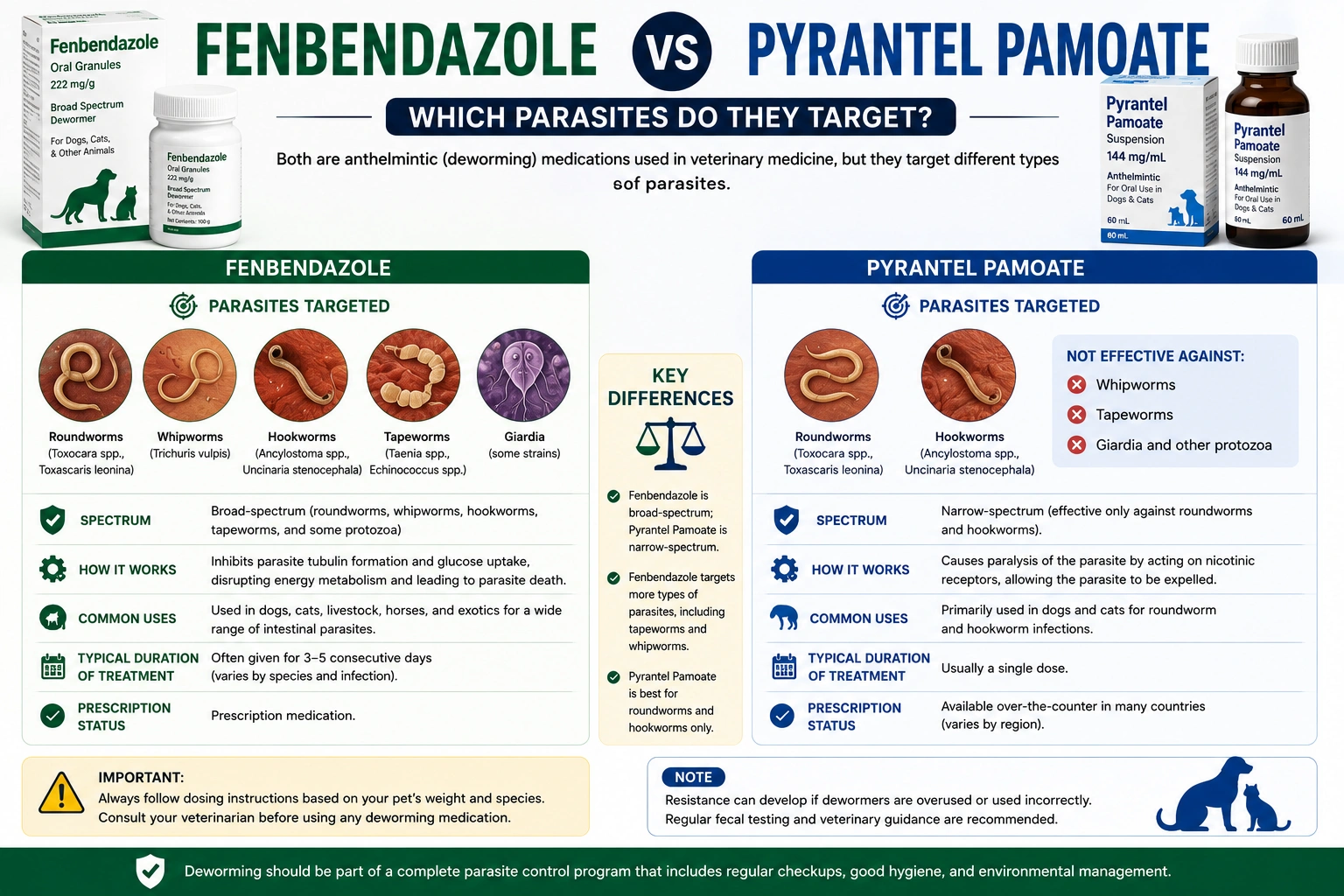
By disrupting microtubule formation, Fenbendazole blocks the parasite’s ability to absorb glucose. Over a course of consecutive daily doses, the parasite gradually depletes its energy reserves and starves to death, eventually being cleared naturally through the host’s digestive tract. Because this metabolic disruption takes time, Fenbendazole typically requires a multi-day treatment course (usually 3 to 5 consecutive days).
2. Pyrantel Pamoate (Tetrahydropyrimidine Class)
Pyrantel Pamoate belongs to the tetrahydropyrimidine family. It acts as a depolarizing neuromuscular blocking agent. Specifically, it stimulates nicotinic acetylcholine receptors at the parasite’s neuromuscular junction, causing severe, prolonged muscle contraction followed by irreversible paralysis.
Once paralyzed, the worm loses its ability to grip or anchor itself to the host’s intestinal wall. The host’s normal intestinal peristalsis then sweeps the live, paralyzed parasite out of the body in the stool. Because Pyrantel acts rapidly on nerve receptors, it is usually administered as a single-dose treatment (often repeated 2 to 4 weeks later to catch newly hatched larvae).
Target Parasite Spectrum: Which Worms Do They Target?
The primary practical difference between Fenbendazole and Pyrantel Pamoate lies in their range of activity. Selecting the right medication requires knowing which specific parasite species is present:
| Parasite Category & Species | Fenbendazole Coverage | Pyrantel Pamoate Coverage |
|---|---|---|
| Roundworms (Toxocara, Toxascaris) | Highly Effective (Clears adult & larval stages) | Highly Effective (Clears adult stages in gut lumen) |
| Hookworms (Ancylostoma, Uncinaria) | Highly Effective (Broad tissue clearance) | Highly Effective (Excellent luminal clearing) |
| Whipworms (Trichuris vulpis) | Highly Effective (Primary choice for Whipworms) | No Activity (Ineffective against Whipworms) |
| Tapeworms (Taenia species) | Effective (Specifically against Taenia spp.) | No Activity (Ineffective against Tapeworms*) |
| Protozoa (Giardia duodenalis) | Highly Effective (First-line clinical therapy) | No Activity (Ineffective against Giardia) |
| Pinworms (Enterobius, Oxyuris) | Effective | Highly Effective (First-line for equine/rodent pinworms) |
*Note: Pyrantel pamoate is ineffective against common tapeworms (Dipylidium/Taenia), though high-dose Pyrantel tartrate formulations are used for specific equine tapeworms (Anoplocephala).
In-Depth Coverage Breakdown
1. Whipworms (Trichuris vulpis): Fenbendazole Wins
Whipworms burrow deep into the mucosal lining of the cecum and large intestine, causing chronic watery diarrhea, weight loss, and anemia. Pyrantel Pamoate has zero activity against whipworms. Fenbendazole is considered a gold-standard treatment for canine whipworm infestations due to its ability to penetrate tissue barriers over a 3-to-5-day dosing cycle.
2. Protozoa (Giardia): Fenbendazole Wins
Giardia is a microscopic protozoan parasite that causes severe, foul-smelling diarrhea and malabsorption. Pyrantel Pamoate targets only muscular helminths and has no effect on protozoa. Fenbendazole disrupts Giardia‘s ventral adhesive disc by binding to its tubulin, making a 3-to-5-day course of Fenbendazole a primary clinical treatment choice for giardiasis in dogs and cats.
3. Roundworms & Hookworms: Both Are Highly Effective
Both medications perform exceptionally well against common roundworms and hookworms. Pyrantel Pamoate is frequently chosen for young puppies and kittens during initial weaning rounds (at 2, 4, 6, and 8 weeks of age) because its single-dose liquid suspension is easy to administer and rapidly clears luminal worms.
Formulations and Dosage Strengths
To accommodate various animal sizes, weight categories, and administration preferences, Fenbendazole is manufactured in several tablet, powder, and topical strength options:
- Low-Dose / Small Animal Formulations: Options such as Fenbendazole 150 Mg Tablets and Fenbendazole 222 Mg Tablets allow precise weight-based dosing for smaller dogs, cats, or small domestic animals.
- Standard Adult Maintenance Strengths: Intermediate and high-potency options like Fenbendazole 444 Mg Tablets and Fenbendazole Tablets 500 Mg are designed for medium to large canine breeds or livestock protocols requiring higher total milligram thresholds over consecutive days.
- Topical & Specialized Preparations: Formulations like Fenbendazole Cream are utilized in specific veterinary dermatological or localized therapeutic applications.
By contrast, Pyrantel Pamoate is most commonly supplied as a sweet, palatable liquid suspension (palatable for young animals) or as chewable tablets.
For a comprehensive, peer-reviewed database detailing the chemical structure, pharmacokinetics, and molecular properties of anthelmintic compounds, consult the National Center for Biotechnology Information (NCBI) PubChem Database.
Safety Profiles and Side Effect Comparisons
Both medications possess broad margins of safety in companion animals, but their side effect profiles differ slightly:
Safety Considerations
Fenbendazole Safety: Extremely well tolerated because it specifically targets parasite tubulin with minimal binding to mammalian tissue. Side effects are rare but may include mild, temporary vomiting or loose stools, usually triggered by the die-off of heavy parasite burdens rather than drug toxicity.
Pyrantel Pamoate Safety: Poorly absorbed from the host’s gastrointestinal tract, which is an advantage since it keeps the drug concentrated inside the intestinal lumen where worms reside. Transient nausea, vomiting, or rapid expulsion of live/paralyzed worms in the stool can occur shortly after administration.
For official international veterinary resources and global animal health guidelines, visit the World Health Organization (WHO) Zoonotic Disease Directory.
Anthelmintic Selection Checklist
Use this quick guide to determine which medication matches your antiparasitic needs:
- ✔️ Identify the Target Parasite: Use Fenbendazole if treating Whipworms, Giardia, or Taenia tapeworms.
- ✔️ For Fast Young Puppy Deworming: Choose Pyrantel Pamoate for easy single-dose clearing of common Roundworms and Hookworms.
- ✔️ Confirm Dosing Duration: Remember that Fenbendazole requires consecutive daily dosing (3–5 days), whereas Pyrantel is typically a single dose.
- ✔️ Calculate by Exact Weight: Weigh the animal accurately to choose the correct milligram tablet strength or suspension volume.
- ✔️ Consult Your Veterinarian: Perform a fecal floatation exam with your vet to confirm the exact parasite species before starting treatment.