

What Is Abiraterone Acetate Tablets Used For? A Guide to Hormone Therapy for Prostate Cancer

What Is Abiraterone Acetate Used For? A Guide to Hormone Therapy for Prostate Cancer
Critical Medical & Oncology Notice
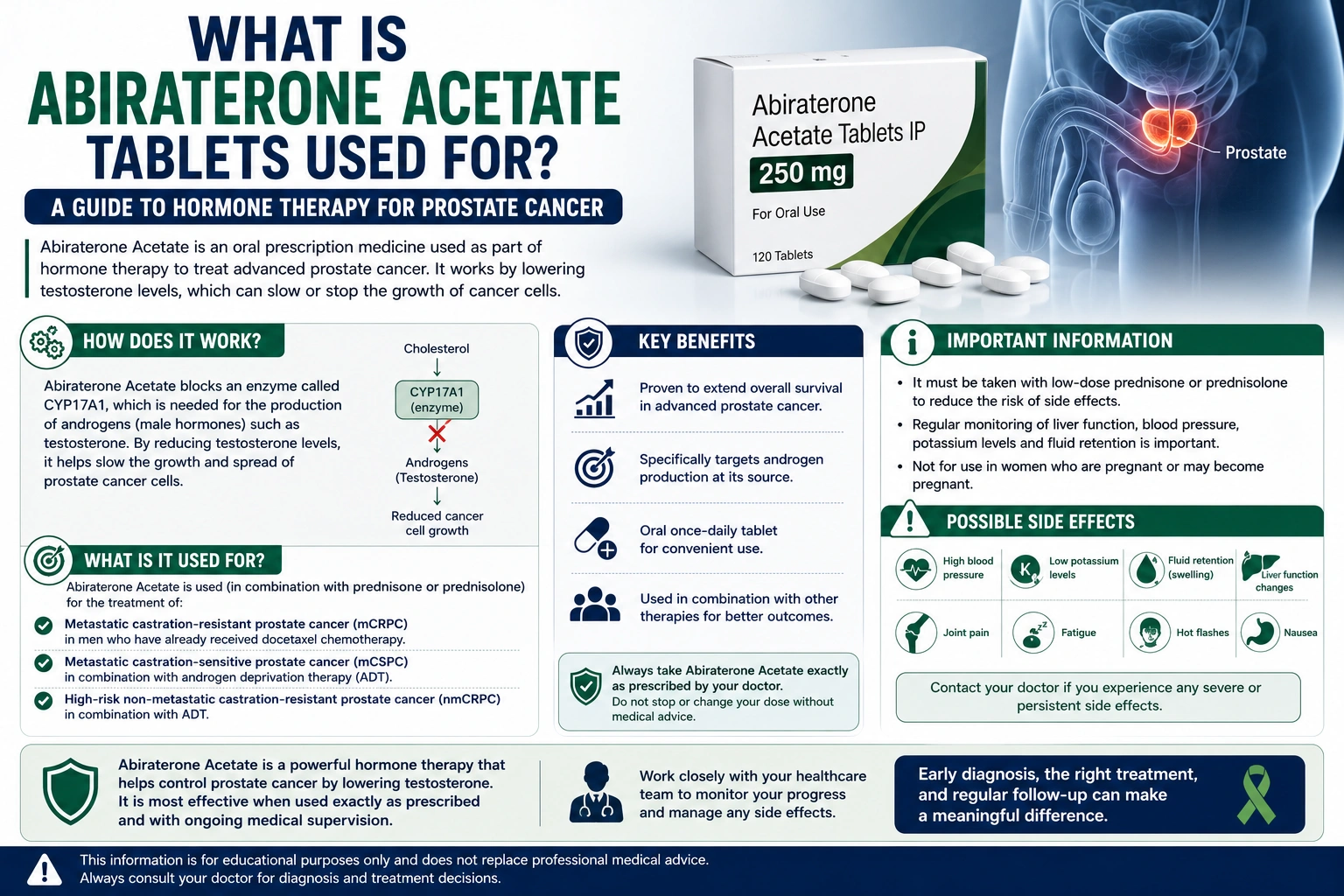
Abiraterone Acetate is a target-specific CYP17 inhibitor indicated for treating metastatic castration-resistant prostate cancer (mCRPC) and metastatic high-risk castration-sensitive prostate cancer (mCSPC). It works by blocking androgen synthesis across all physiological sources. Abiraterone Acetate must be co-administered with Prednisone or Prednisolone to prevent mineralocorticoid excess and must only be initiated and monitored under direct oncological supervision. Mandatory routine monitoring of liver function (ALT/AST), serum potassium, and blood pressure is required. This document serves strictly educational purposes.
Prostate cancer growth is heavily driven by male sex hormones known as androgens (primarily testosterone and dihydrotestosterone). Standard Androgen Deprivation Therapy (ADT)—such as surgical castration or LHRH agonist/antagonist injections—shuts down hormone production in the testicles. However, advanced prostate cancer cells can adapt, continuing to grow by utilizing residual androgens produced elsewhere in the body.
To overcome this therapeutic barrier, medical oncology utilizes **Abiraterone Acetate**, a next-generation target-specific androgen synthesis inhibitor. By shutting down androgen production at all physiological sites, Abiraterone Acetate starves prostate cancer cells of the hormones needed for disease progression.
Understanding Abiraterone Acetate requires an examination of its unique enzymatic target, its core clinical indications, the physiological necessity of co-administering corticosteroid therapy, its side effect profile, and essential safety guidelines.
Mechanism of Action: Triple-Site Androgen Blockade
Unlike traditional anti-androgens that block hormone receptors (such as Bicalutamide), Abiraterone Acetate targets the enzyme responsible for producing androgens at their source:
Targeting CYP17 Inhibitory Pathways
1. CYP17 Enzyme Inhibition: Abiraterone Acetate selectively and irreversibly inhibits the cytochrome P450 17A1 (CYP17) enzyme complex, which possesses dual $17\alpha$-hydroxylase and 17,20-lyase activities. This enzyme is required for steroidogenesis.
2. Blocking All Three Androgen Sources: By inhibiting CYP17, Abiraterone stops testosterone synthesis in three distinct locations:
- The Testicles (Testicular tissue)
- The Adrenal Glands (Adrenal tissue)
- The Prostate Tumor Tissue itself (Intra-tumoral synthesis)
3. Halting Tumor Progression: Completely shutting down adrenal and intra-tumoral androgen synthesis deprives castration-resistant prostate cancer cells of the local hormones needed to fuel growth.
In clinical oncology, daily maintenance options are prescribed depending on the specific regimen structure:
- Standard Multi-Tablet Dosing: Formulations like Abiraterone Acetate Tablets 250 Mg – Generic Zytiga are administered as four 250 mg tablets once daily (totaling 1,000 mg).
- Streamlined High-Potency Dosing: Formulations like Abiraterone Acetate Tablets 500 Mg – Generic Zytiga allow a streamlined two-tablet daily regimen (1,000 mg total) to improve patient compliance.
Primary Clinical Indications in Advanced Prostate Cancer
Abiraterone Acetate is FDA-approved for specific advanced stages of prostate adenocarcinoma:
1. Metastatic Castration-Resistant Prostate Cancer (mCRPC)
Indicated for patients whose prostate cancer has metastasized and no longer responds to surgical or medical castration (low serum testosterone levels). It is prescribed for both chemotherapy-naïve patients and those who have previously received docetaxel-based chemotherapy regimens.
2. Metastatic High-Risk Castration-Sensitive Prostate Cancer (mCSPC)
Prescribed in combination with standard ongoing ADT for newly diagnosed patients with newly metastasized, high-risk disease before the tumor develops castration resistance, significantly extending overall survival rates.
Clinical Overview Matrix
The table below outlines the core parameters, clinical indications, and monitoring requirements for Abiraterone Acetate therapy:
| Parameter | Clinical Detail | Monitoring & Safety Requirement |
|---|---|---|
| Pharmacological Class | CYP17 Inhibitor (Targeted Steroidogenesis Inhibitor) | Must be taken on an empty stomach (1 hr before or 2 hrs after meals). |
| Standard Daily Dose | 1,000 mg once daily (4 x 250 mg or 2 x 500 mg tablets) | Must be co-administered with daily low-dose Prednisone/Prednisolone. |
| Core Clinical Role | Metastatic Castration-Resistant & High-Risk Castration-Sensitive Prostate Cancer | Must continue ongoing background ADT (e.g., LHRH agonists/antagonists). |
| Primary Safety Metrics | Liver Function Tests (ALT, AST, Bilirubin), Potassium, Blood Pressure | Bi-weekly LFT checks for the first 3 months; monthly blood pressure and electrolyte tracking. |
Why Prednisone Co-Administration Is Mandatory
A critical aspect of Abiraterone Acetate therapy is that it **must always be taken alongside low-dose oral corticosteroids** (such as 5 mg Prednisone taken once or twice daily).
Inhibiting the CYP17 enzyme blocks the production of cortisol in the adrenal glands. Reduced cortisol triggers a feedback loop in the pituitary gland, causing an overproduction of Adrenocorticotropic Hormone (ACTH). Elevated ACTH drives excess mineralocorticoid synthesis, leading to clinical complications:
- Severe Fluid Retention (Edema): Swelling in the lower legs, feet, and lungs.
- Hypertension: Dangerous spikes in systemic blood pressure.
- Hypokalemia: Severe depletion of blood potassium levels, triggering cardiac arrhythmias.
Co-administering low-dose Prednisone replaces missing systemic cortisol, suppressing excess ACTH release and preventing these mineralocorticoid side effects.
Potential Side Effects & Adverse Event Management
While Abiraterone Acetate is generally well-tolerated when combined with Prednisone, certain side effects require ongoing clinical oversight:
1. Food Interaction & Bioavailability Risks
Abiraterone Acetate exhibits an extreme food effect. Taking tablets with food increases systemic absorption up to 10-fold in an unpredictable manner, significantly heightening toxicity risks. Tablets must always be taken on an empty stomach—at least 1 hour before eating or 2 hours after a meal—with a full glass of water.
2. Hepatotoxicity (Liver Stress)
Elevations in liver enzymes (ALT and AST) occur in a subset of patients. Serum transaminases and bilirubin levels must be measured prior to starting treatment, every two weeks for the first three months, and monthly thereafter. Severe LFT elevations require immediate dose modification or temporary treatment interruption.
3. Cardiovascular Risks
Because of potential fluid retention and electrolyte shifts, patients with pre-existing ischemic heart disease, heart failure, or severe hypertension require close cardiac monitoring during therapy.
For an exhaustive, peer-reviewed database detailing the chemical structure, pharmacokinetics, and molecular properties of Abiraterone Acetate, consult the National Center for Biotechnology Information (NCBI) PubChem Database.
For official international medical directives and oncology treatment guidelines, visit the World Health Organization (WHO) Cancer Directory.
Abiraterone Acetate Treatment Safety Checklist
Keep these core clinical guidelines in mind throughout therapy:
- ✔️ Take on a Completely Empty Stomach: Swallow tablets with water at least 1 hour before or 2 hours after food.
- ✔️ Never Skip Prescribed Prednisone: Take your corticosteroid daily as prescribed to prevent mineralocorticoid side effects.
- ✔️ Maintain Background ADT: Continue your background LHRH agonist/antagonist therapy unless directed otherwise by your oncologist.
- ✔️ Complete Scheduled Bloodwork: Keep up with bi-weekly LFT, potassium, and PSA blood tests during initial treatment phases.
- ✔️ Monitor Blood Pressure & Swelling: Track your blood pressure regularly and report ankle swelling, shortness of breath, or muscle weakness immediately.