


Modafinil vs Armodafinil: Differences in Duration, Dosage, Effects and Safety

Medically sourced comparison | Updated 3 November 2026
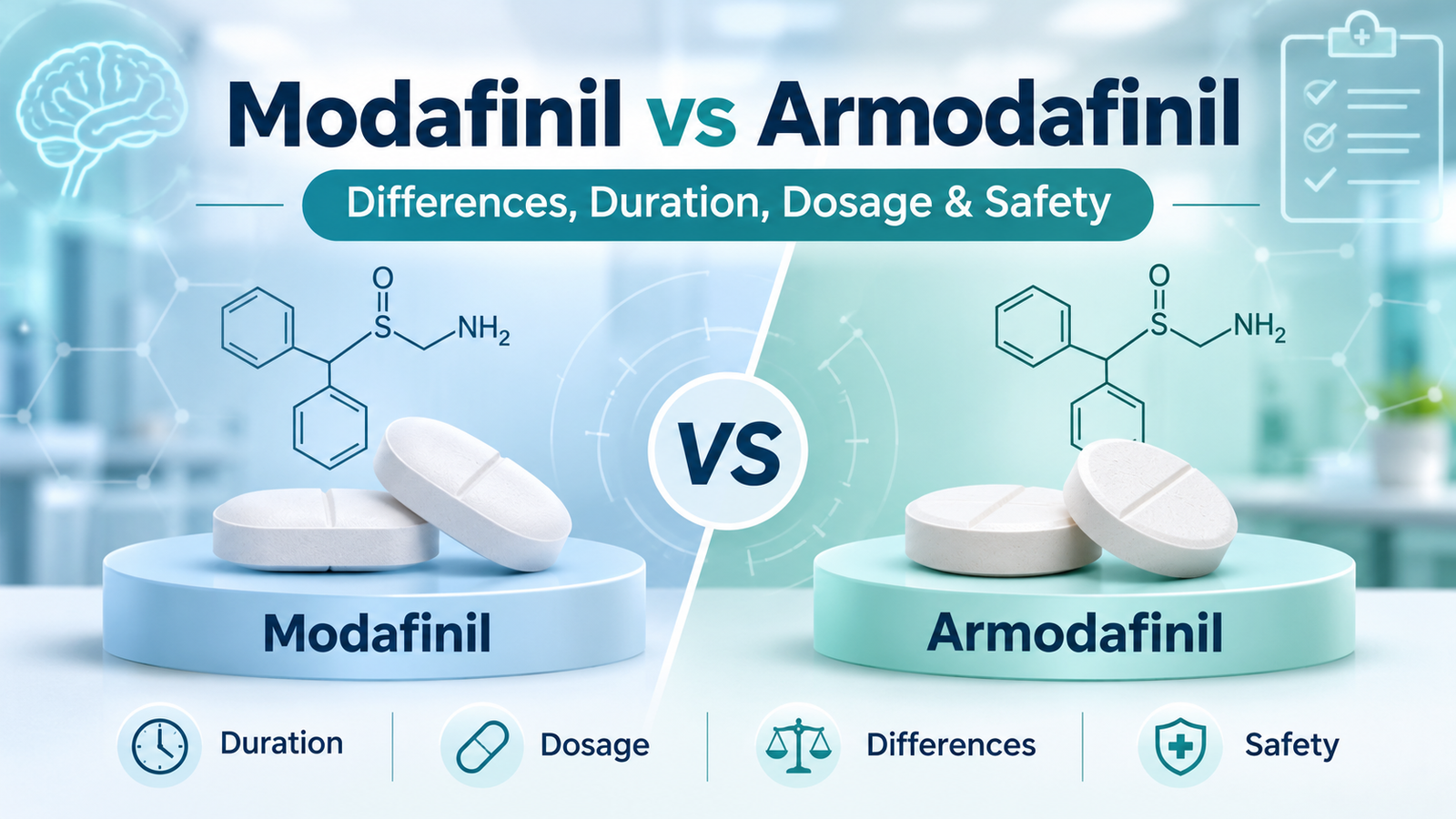
Modafinil and armodafinil are prescription wakefulness-promoting medicines used in adults with excessive sleepiness related to narcolepsy, obstructive sleep apnea (OSA), or shift work disorder. They are closely related, but they are not identical. If you are comparing modafinil vs armodafinil, the meaningful differences involve their chemical composition, the way the body processes them, prescribing doses, and how an individual’s symptoms and adverse effects respond. Neither medicine replaces adequate sleep or treatment of the underlying sleep disorder.
Quick answer: Modafinil contains both the R- and S-forms of the molecule; armodafinil contains the R-form alone. The R-form is eliminated more slowly, which can lead to greater later-day exposure with armodafinil in certain comparisons. That does not mean it is consistently better, safer or suitable at an interchangeable milligram dose.
Modafinil vs Armodafinil: Quick Comparison Table
| Feature | Modafinil | Armodafinil |
|---|---|---|
| US reference brand | Provigil | Nuvigil |
| Active molecule | R- and S-modafinil (racemic mixture) | R-modafinil only |
| US-approved adult uses | Excessive sleepiness due to narcolepsy, OSA and shift work disorder | The same three conditions |
| Typical US labelled narcolepsy / OSA dose | 200 mg once in the morning | 150–250 mg once in the morning |
| Typical US labelled shift-work dose | 200 mg about one hour before shift | 150 mg about one hour before shift |
| Duration | Long acting; varies by individual | Long acting; R-enantiomer has an apparent half-life of about 15 hours |
| Important risks | Serious rash, psychiatric or cardiovascular effects, interactions, impaired contraceptive effectiveness | Similar serious warnings and interactions |
These are reference-label doses, not instructions for self-treatment. Doses are not directly interchangeable, and product approval and prescribing rules vary by country.
What Is Modafinil?
Modafinil is a centrally acting wakefulness-promoting prescription medicine. Its US reference brand is Provigil. Modafinil contains two mirror-image forms (enantiomers) of the same molecule. Its precise mechanisms are not fully understood; effects on dopamine transport and other alertness pathways are relevant. It is not a cure for narcolepsy or obstructive sleep apnea.
Pinkline Exports lists Modvigil 200 mg (modafinil). That product page is a catalogue reference; suitability, supply and import requirements should be checked with a licensed clinician and local regulations. For a fuller overview, see What Is Modvigil? Uses, Dosage, Side Effects and Safety.
What Is Armodafinil?
Armodafinil contains the R-enantiomer of modafinil and is marketed under the US reference brand Nuvigil. Because the S-form of modafinil clears more rapidly, the single-enantiomer formulation has a different concentration-over-time profile. The armodafinil label reports an apparent terminal half-life of approximately 15 hours. Half-life is not a guarantee of the number of hours someone will feel awake or alert.
Relevant Pinkline catalogue pages are Waklert 150 (armodafinil) and Waklert 50 (armodafinil). These strengths should not be treated as equivalent to a particular milligram strength of modafinil without a prescriber’s assessment.
Is Armodafinil Stronger Than Modafinil?
There is no universally correct “stronger” answer. For the same numerical milligram dose, the amount and persistence of the R-enantiomer differ between products. Drug exposure data show pharmacokinetic differences, but a lab comparison does not establish that one medicine has superior clinical outcomes for everyone. Effectiveness and tolerability vary among patients and indications, and direct milligram-for-milligram substitution is inappropriate.
Patients should not combine modafinil and armodafinil or increase either dose to compensate for sleep deprivation. A sleep specialist may consider timing, response, other medical conditions and interactions before choosing a treatment.
Which Lasts Longer: Modafinil or Armodafinil?
Both medicines are generally long acting. Armodafinil may maintain relatively greater R-enantiomer exposure later after dosing, but the practical experience depends on when the dose is taken, food, other medications and individual metabolism. Persistent effects can interfere with sleep, especially when taken late. Do not assume that reported half-life equals the duration of useful alertness.
For a broader explanation of timing and persistence, see How Long Does Modafinil Last?.
How Are They Used for Narcolepsy, OSA and Shift Work Disorder?
Narcolepsy
Both agents are used to improve wakefulness in adults with narcolepsy-associated excessive daytime sleepiness. Diagnosis, symptom monitoring and the need for other treatments belong with a sleep clinician.
Obstructive sleep apnea
Modafinil and armodafinil may improve residual excessive sleepiness but do not keep an obstructed airway open. Effective treatment such as CPAP remains essential when prescribed.
Shift work disorder
The medicines may be prescribed for excessive sleepiness associated with shift work disorder, with timing guided by the work schedule and clinician instructions. Neither replaces an adequate sleep opportunity or treatment of another cause of tiredness. Read Modafinil for Shift Work Sleep Disorder for additional background.
Modafinil and Armodafinil Side Effects
Common effects can include headache, nausea, dizziness, anxiety, reduced appetite or trouble sleeping. Important but less frequent risks include serious skin reactions (including Stevens–Johnson syndrome), severe allergic reactions, mood or psychiatric symptoms and cardiovascular effects. Stop the medicine and seek urgent care for a concerning rash, mouth sores, facial swelling, severe mental-status changes, chest pain or other serious symptoms. Patients should not drive until they know how treatment affects their alertness.
Drug Interactions, Contraception and Pregnancy
Both medicines can reduce the effectiveness of some hormonal contraceptives. US product information recommends alternative or additional contraception during treatment and for one month after discontinuation; local guidance and individual contraceptive methods should also be reviewed with a professional. They may also interact with cyclosporine, some seizure medicines, diazepam and other drugs affected by hepatic enzymes. Both have pregnancy-related warnings. Tell the prescriber about all medicines, supplements and medical conditions before starting or changing treatment.
Can You Switch From Modafinil to Armodafinil?
A clinician may consider switching after assessing sleep-disorder control, tolerability and interactions, but there is no simple universal dose conversion. Do not take both together unless a qualified prescriber explicitly directs it. If daytime sleepiness persists, clinicians should reassess sleep duration, adherence to OSA treatment, other medical causes and possible medication effects before changing therapy.
Waklert vs Modvigil: Understanding the Product Names
Waklert is a brand associated with armodafinil and Modvigil is associated with modafinil. They should be understood in the context of their labelled active ingredients rather than assumed to be interchangeable brand variants. Compare the product information for Waklert 150 (armodafinil), Waklert 50 (armodafinil) and Modvigil 200 mg (modafinil). These links are for reference and product identification, not a recommendation to purchase or self-prescribe.
Frequently Asked Questions
Are modafinil and armodafinil the same drug?
No. They are related: modafinil contains R- and S-enantiomers, while armodafinil contains only the R-enantiomer.
Is armodafinil better for studying or productivity?
These are not their US-approved indications. Evidence about off-label cognitive enhancement does not establish routine safety or appropriateness in otherwise healthy people.
Can armodafinil replace sleep?
No. Neither drug substitutes for sufficient sleep or treatment of sleep apnea.
Can I take modafinil 200 mg instead of armodafinil 150 mg?
Not without your prescriber. Their doses are not directly interchangeable on a milligram basis.
Which has fewer side effects?
Neither is reliably safer for every patient; both have important warnings, interactions and individual tolerability considerations.
Sources and Medical Review Notes
- DailyMed: Provigil (modafinil) prescribing information
- DailyMed: Nuvigil (armodafinil) prescribing information
- MedlinePlus: Armodafinil
Editorial note: This article draws on US prescribing information. A clinician has not been represented as having personally reviewed this page; formal clinical sign-off should be completed before labeling it “medically reviewed.”
Medical disclaimer: Educational information only; not medical advice, a diagnosis or a prescription. Consult a licensed healthcare professional regarding appropriate treatment, interactions, dosing and your country’s prescription/import requirements.