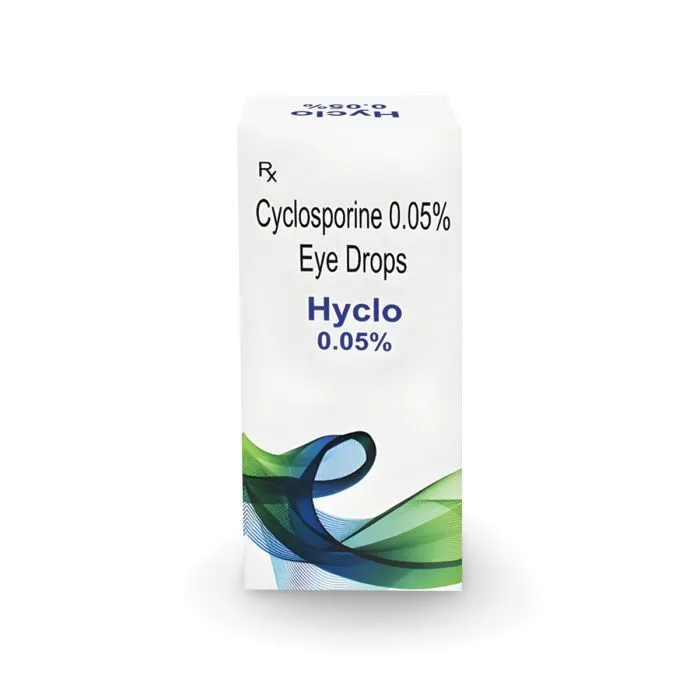
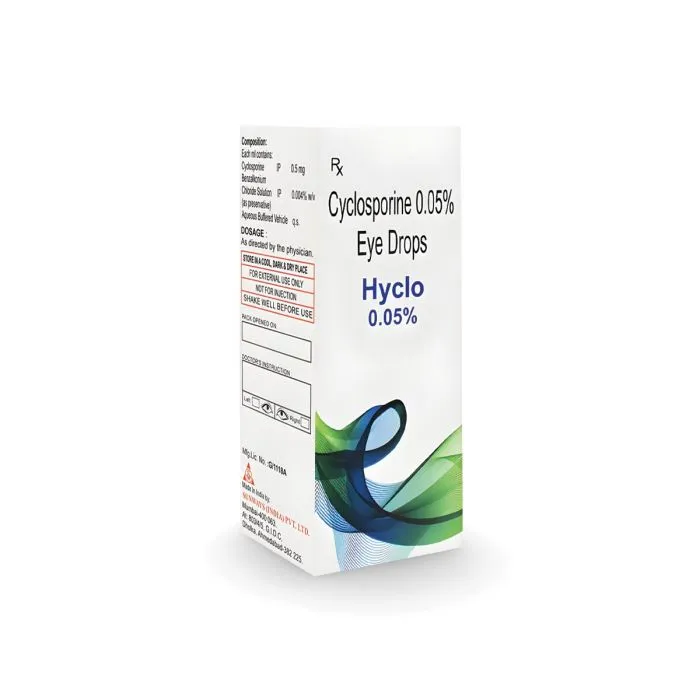
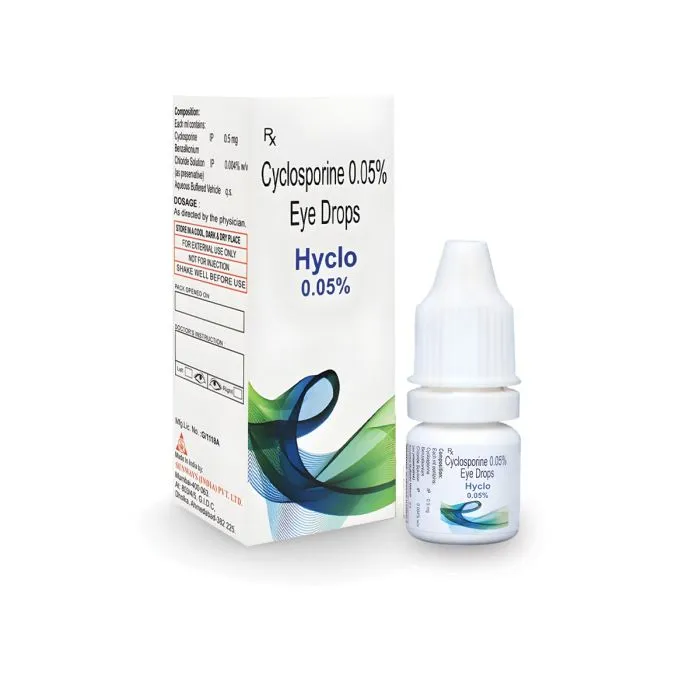
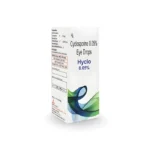
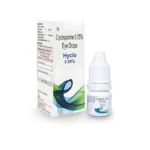
Hyclo 0.05% Eye Drop (5 ml) – Calcineurin Inhibitor for Chronic Dry Eye
Hyclo 0.05% Eye Drop (5 ml) is a topical ophthalmic formulation containing cyclosporine, clinically indicated for increasing natural tear production in patients whose tear production is presumed to be suppressed due to ocular surface inflammation associated with keratoconjunctivitis sicca (chronic dry eye disease). By selectively inhibiting calcineurin-dependent T-cell activation, it targets ocular surface inflammation to restore endogenous tear film balance and protect corneal integrity.
Cyclosporine 0.05%
5 ml Bottle
Calcineurin Inhibitor
Prescription Ophthalmic
Active Ingredient
Cyclosporine (0.05% w/v)
Pack Size
5 ml Dropper Bottle
Therapeutic Class
Topical Calcineurin Inhibitor Immunosuppressant
Dosage Form
Sterile Ophthalmic Solution / Emulsion
What Is Hyclo 0.05% Eye Drop (5 ml)?
Hyclo 0.05% is an ophthalmic preparation containing cyclosporine, a cyclic polypeptide immunomodulating agent. Supplied in a 5 ml multi-dose dropper bottle, it is formulated to manage the chronic inflammatory cycle that underlies keratoconjunctivitis sicca (dry eye disease).
Unlike conventional artificial tears that provide temporary surface lubrication, Hyclo 0.05% is a disease-modifying topical therapy. It addresses chronic cell-mediated inflammation within the lacrimal functional unit and conjunctiva, stimulating natural aqueous tear production from the patient’s own glands.
Because Hyclo targets underlying immunological pathways rather than acting as an immediate lubricant, therapeutic results build progressively. Noticeable improvements in natural tear production and ocular comfort typically develop over 4 to 12 weeks of continuous twice-daily therapy.
([dailymed.nlm.nih.gov](https://dailymed.nlm.nih.gov/dailymed/lookup.cfm?setid=a00e5ba6-df27-4a00-bebe-8dfda8537b01))
How Does Hyclo 0.05% Work?
Chronic dry eye disease involves immune-driven ocular surface distress where activated helper T-lymphocytes release inflammatory mediators that disrupt tear gland secretion:
- Intracellular Complex Formation: Cyclosporine enters lymphocytes and binds selectively to the cytoplasmic protein cyclophilin, forming an active immunosuppressive complex.
- Calcineurin Phosphatase Inhibition: This complex inhibits calcineurin, a calcium/calmodulin-dependent phosphatase essential for dephosphorylating the Nuclear Factor of Activated T-cells (NF-AT).
- Suppression of Cytokine Transcription: By preventing NF-AT translocation into the cell nucleus, it blocks the transcription and release of pro-inflammatory cytokines, specifically interleukin-2 (IL-2), interferon-gamma (IFN-γ), and tumor necrosis factor-alpha (TNF-α).
- Restoration of the Lacrimal Unit: Downregulating surface inflammation reduces apoptosis of conjunctival goblet cells, preserves mucin layers, and restores the neural signaling needed for the lacrimal gland to resume natural aqueous tear production.
Because cyclosporine acts via immunomodulation rather than corticosteroid pathways, it treats chronic ocular surface inflammation without elevating intraocular pressure or causing posterior subcapsular cataracts.
What Is Hyclo 0.05% Used For?
Hyclo 0.05% Eye Drop is clinically indicated for the management of chronic ocular surface inflammatory conditions in adults:
- Keratoconjunctivitis Sicca (Chronic Dry Eye Disease): Increasing tear production in patients whose natural tear output is suppressed by ocular surface inflammation.
- Autoimmune-Mediated Dry Eye: Management of severe dry eye associated with underlying systemic conditions, including Sjögren’s syndrome and rheumatoid arthritis.
- Corneal Epithelial Protection: Reducing superficial punctate keratitis, corneal staining, and epithelial breakdown resulting from chronic tear deficiency.
- Conjunctival Mucin Layer Recovery: Increasing conjunctival goblet cell density to enhance tear film stability and break-up time (TBUT).
Hyclo is not indicated for treating acute viral, bacterial, or fungal ocular infections, allergic conjunctivitis, or dry eye caused by mechanical lacrimal duct obstruction.
([dailymed.nlm.nih.gov](https://dailymed.nlm.nih.gov/dailymed/lookup.cfm?setid=a00e5ba6-df27-4a00-bebe-8dfda8537b01))
Related Preservative-Free Formulation
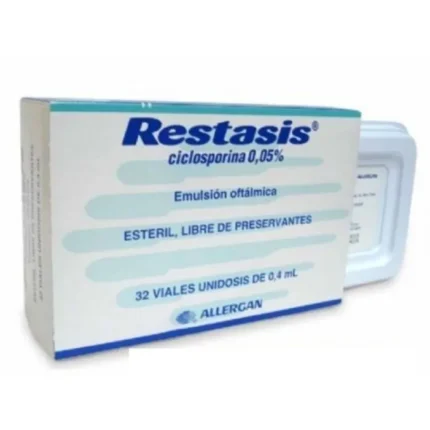
For single-use, preservative-free unit-dose packaging of topical cyclosporine 0.05%, explore our detailed product profile on Restasis:
Restasis 0.05% Ophthalmic Emulsion 0.4ml
Hyclo 0.05% Dosage and Administration
Adherence to proper application technique ensures optimal corneal exposure and preserves solution sterility:
- Standard Dosing: Instill 1 drop into each affected eye twice daily, approximately 12 hours apart.
- Invert Before Use: Gently invert the bottle several times prior to instillation to ensure uniform dispersion of the cyclosporine emulsion.
- Administration Technique: Tilt the head back, gently pull down the lower eyelid to form a conjunctival pouch, look upward, and instill 1 drop. Close the eye gently for 1 to 2 minutes without squeezing or hard blinking.
- Spacing with Other Drops: If using artificial tears, lubricating gels, or other eye drops concurrently, wait at least 15 minutes between applications to prevent washing out the cyclosporine dose.
Do not touch the dropper tip to the eye, eyelashes, fingers, or any external surface to maintain bottle sterility.
([dailymed.nlm.nih.gov](https://dailymed.nlm.nih.gov/dailymed/lookup.cfm?setid=a00e5ba6-df27-4a00-bebe-8dfda8537b01))
Contact Lens Precaution:
Patients with reduced tear production should generally avoid wearing contact lenses. If lenses are worn, remove them prior to instillation of Hyclo and wait at least 15 minutes before reinserting.
Hyclo 0.05% vs Restasis 0.05% Ophthalmic Emulsion
Both preparations supply the identical active concentration of cyclosporine (0.05%), but their bottle presentations and unit formats differ:
| Feature |
Hyclo 0.05% Eye Drop (5 ml) |
Restasis 0.05% (0.4 ml) |
| Active Ingredient |
Cyclosporine 0.05% w/v |
Cyclosporine 0.05% w/v |
| Packaging Format |
5 ml multi-dose dropper bottle |
Single-use preservative-free vials (0.4 ml) |
| Primary Indication |
Suppressed tear production (Keratoconjunctivitis sicca) |
Suppressed tear production (Keratoconjunctivitis sicca) |
| Dosing Schedule |
1 drop twice daily (12 hours apart) |
1 drop twice daily (12 hours apart) |
| Therapeutic Target |
Calcineurin / T-cell inflammatory pathway |
Calcineurin / T-cell inflammatory pathway |
Both formulations deliver equivalent calcineurin inhibition to increase natural tear production; choice depends on preference between a multi-dose 5 ml bottle or single-use 0.4 ml unit-dose vials.
Who Should Not Use Hyclo 0.05%?
Hyclo is contraindicated or requires specific medical precautions in the following situations:
- Known hypersensitivity or allergic reaction to cyclosporine or any formulation excipients (such as castor oil, polysorbate 80, carbomer copolymer)
- Active ocular infections (bacterial, fungal, or viral keratitis/conjunctivitis); local immunomodulation can impair host antimicrobial defenses
- Children under 16 years of age (safety and clinical effectiveness have not been established in pediatric dry eye populations)
- Wearing contact lenses during active ocular surface inflammation
- Pregnancy and breastfeeding (use only if explicitly determined essential by an ophthalmologist and obstetrician)
Patients with a history of recurrent herpes simplex keratitis require careful slit-lamp evaluation prior to starting calcineurin inhibitor eye drops.
([dailymed.nlm.nih.gov](https://dailymed.nlm.nih.gov/dailymed/lookup.cfm?setid=a00e5ba6-df27-4a00-bebe-8dfda8537b01))
Possible Side Effects of Hyclo 0.05%
Systemic absorption of cyclosporine following topical ocular instillation is negligible; adverse effects are predominantly localized to the ocular surface:
- Ocular Burning & Stinging: The most common adverse effect, typically occurring immediately after drop instillation and subsiding as the corneal epithelial surface heals over weeks.
- Conjunctival Hyperemia: Mild transient redness or vascular injection of the sclera.
- Visual Blurring: Temporary slight blurring immediately following administration due to the viscous nature of the emulsion vehicle.
- Epiphora & Secretions: Transient reflex tearing or sticky ocular discharge.
- Foreign Body Sensation: Grittiness, ocular irritation, or mild eyelid erythema.
If severe, persistent eye pain, worsening corneal erosion, or signs of secondary ocular infection occur, discontinue use and consult an ophthalmologist promptly.
([dailymed.nlm.nih.gov](https://dailymed.nlm.nih.gov/dailymed/lookup.cfm?setid=a00e5ba6-df27-4a00-bebe-8dfda8537b01))
Drug Interactions & Co-Administration Guidelines
Blood concentrations of cyclosporine following topical ocular administration remain below detectable assay limits (< 0.1 ng/mL), making systemic cytochrome P450 drug interactions clinically negligible:
Separation from Lubricating Drops: When using artificial tears, gels, or ointments, space administrations by at least 15 minutes to prevent the tear substitute from diluting or washing away the active cyclosporine dose.
Concomitant Topical Corticosteroids: Short-term topical steroid drops may occasionally be co-prescribed as a temporary bridge to reduce acute surface inflammation or early stinging while cyclosporine establishes therapeutic control; long-term combination requires regular monitoring of intraocular pressure.
([dailymed.nlm.nih.gov](https://dailymed.nlm.nih.gov/dailymed/lookup.cfm?setid=a00e5ba6-df27-4a00-bebe-8dfda8537b01))
Treatment Timeline & Clinical Expectations
Because Hyclo treats the underlying autoimmune inflammatory cycle rather than acting as a temporary surface lubricant, clinical results follow a gradual timeline:
Weeks 1–4 (Adaptation Phase): Patients may experience mild transient burning upon instillation. Tear output is typically unchanged during this early period; lubricating drops may be continued for interim comfort.
Weeks 6–12 (Early Cellular Response): Ocular surface inflammation declines, corneal staining scores improve, and early increases in natural tear production may be detected via Schirmer testing.
Months 3–6 (Sustained Maintenance): Significant improvements in natural tear production, goblet cell restoration, and sustained relief from chronic dry eye symptoms are typically observed with continuous twice-daily therapy.
([dailymed.nlm.nih.gov](https://dailymed.nlm.nih.gov/dailymed/lookup.cfm?setid=a00e5ba6-df27-4a00-bebe-8dfda8537b01))
Handling, Storage, and Bottle Care
Store Hyclo 0.05% Eye Drop at controlled room temperature ($15^\circ\text{C to }25^\circ\text{C}$), away from excessive heat, moisture, direct sunlight, and freezing conditions.
Keep the bottle tightly closed when not in use. To preserve solution sterility and prevent bacterial or fungal colonization, avoid touching the dropper tip to any surface and discard the bottle 4 weeks after first opening.
Official Medical Reference
For authoritative pharmacology monographs, clinical trial data, official safety warnings, and prescribing guidelines on cyclosporine ophthalmic formulations, consult the official FDA DailyMed reference:
DailyMed – Cyclosporine Ophthalmic Emulsion Information
Frequently Asked Questions About Hyclo 0.05% Eye Drop
1. How long does it take for Hyclo 0.05% to start working?
Hyclo does not provide instant surface lubrication like artificial tears. Because it works by reducing underlying immune-mediated inflammation, meaningful increases in natural tear production and symptom relief typically develop over 4 to 12 weeks, with peak benefits seen around 3 to 6 months of continuous twice-daily use.
([dailymed.nlm.nih.gov](https://dailymed.nlm.nih.gov/dailymed/lookup.cfm?setid=a00e5ba6-df27-4a00-bebe-8dfda8537b01))
2. Is a burning or stinging sensation normal after instilling Hyclo?
Yes. Mild ocular burning and stinging is the most commonly reported side effect. It occurs primarily during the early weeks of therapy when the ocular surface is inflamed and typically diminishes as the corneal epithelial barrier heals with continued use.
3. Can I use artificial tears while taking Hyclo 0.05%?
Yes. Lubricating drops may be used concurrently to provide immediate surface comfort while Hyclo works on underlying inflammation. Ensure you space artificial tears and Hyclo by at least 15 minutes to avoid diluting the cyclosporine dose.
([dailymed.nlm.nih.gov](https://dailymed.nlm.nih.gov/dailymed/lookup.cfm?setid=a00e5ba6-df27-4a00-bebe-8dfda8537b01))
4. Can I wear contact lenses while being treated with Hyclo?
Patients with reduced tear production should generally avoid wearing contact lenses. If contact lenses are used, remove them before instilling Hyclo and wait at least 15 minutes before putting them back in.
5. What is the difference between Hyclo 0.05% and Restasis 0.05%?
Both contain 0.05% cyclosporine and work via identical immunomodulatory mechanisms to increase natural tear production. Hyclo is supplied in a multi-dose 5 ml dropper bottle, whereas Restasis is packaged in single-use, preservative-free 0.4 ml unit-dose vials.
Medical Disclaimer
This product overview is provided strictly for educational and informational purposes. Hyclo 0.05% Eye Drop (cyclosporine) is a prescription ophthalmic medication that must only be initiated, dosed, and monitored under the care of a licensed ophthalmologist or optometrist. Individual therapeutic response, tolerance, and underlying ocular surface disease etiology require specialized clinical evaluation. This document does not replace professional medical evaluation, clinical diagnosis, or personalized ophthalmic management.




Reviews
There are no reviews yet.