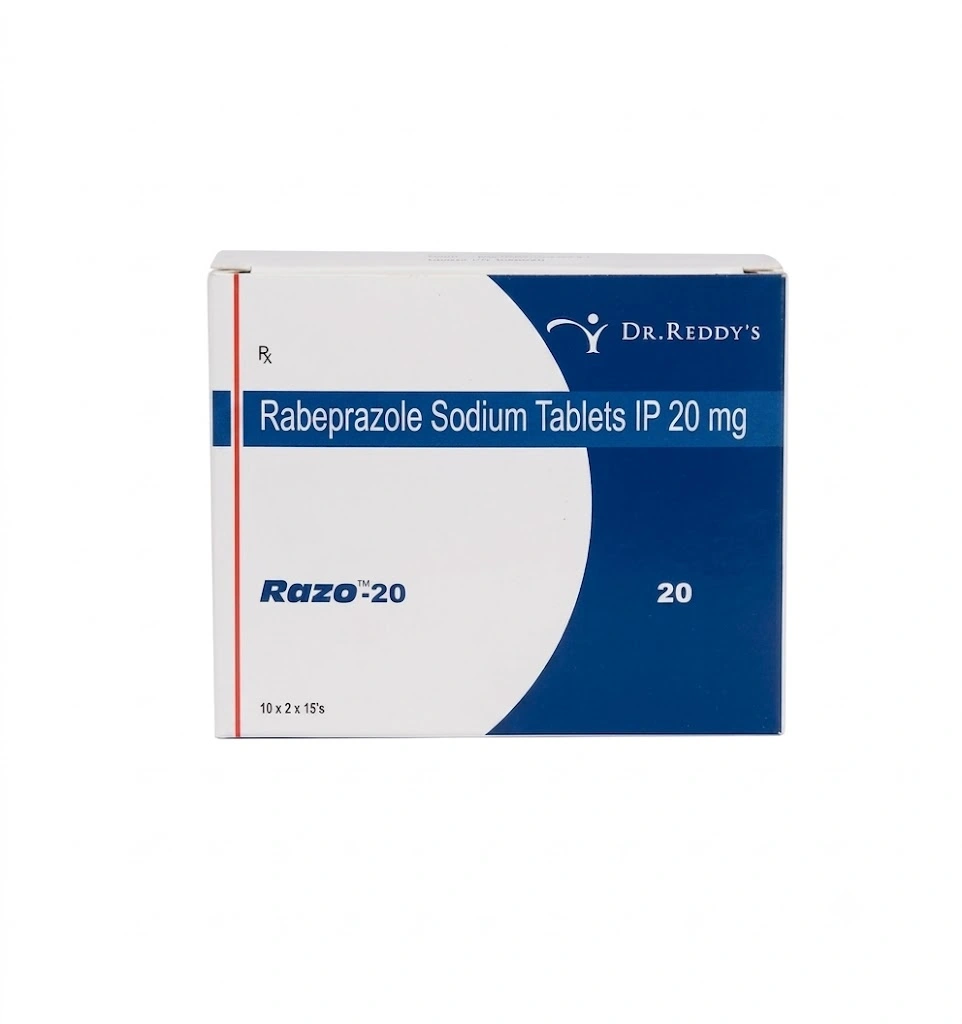
Razo 20 Mg Tablet (Rabeprazole) – Rapid-Acting Proton Pump Inhibitor
Razo 20 Mg Tablet (Rabeprazole) is an oral delayed-release proton pump inhibitor (PPI) indicated for the treatment and healing of erosive gastroesophageal reflux disease (GERD), symptomatic daytime and nighttime heartburn, active duodenal ulcers, and pathological hypersecretory disorders such as Zollinger-Ellison syndrome. Featuring rapid acid activation at a broader pH range, it effectively suppresses gastric H+/K+ ATPase activity to provide fast, sustained acid control.
Rabeprazole Sodium
20 Mg
Proton Pump Inhibitor (PPI)
Prescription Medicine
Active Ingredient
Rabeprazole Sodium
Drug Class
Substituted Benzimidazole / PPI
Dosage Form
Delayed-Release Enteric-Coated Tablet
What Is Razo 20 Mg?
Razo 20 Mg is an enteric-coated delayed-release tablet containing rabeprazole sodium, a substituted benzimidazole compound that belongs to the proton pump inhibitor class. It is engineered to block the final phase of gastric acid production within the stomach’s parietal cells.
Rabeprazole has a high pKa (~5.0), allowing it to convert into its active sulfenamide form rapidly, even in less acidic environments. Because of this property, Razo 20 Mg achieves rapid onset of antisecretory activity from the very first dose compared to older traditional PPIs.
Razo 20 Mg is indicated for the acute relief and mucosal healing of acid-peptic disorders, maintenance therapy in erosive esophagitis, and as a component of combination antibiotic regimens for Helicobacter pylori clearance.
([dailymed.nlm.nih.gov](https://dailymed.nlm.nih.gov/dailymed/drugInfo.cfm?setid=45092108-7c4a-48f9-8222-ca8612e82189&audience=consumer))
How Does Razo 20 Mg Work?
Gastric parietal cells generate hydrochloric acid through the active proton pumping mechanism of the H+/K+ ATPase enzyme system located at the secretory surface.
- Rapid Acid Activation: After absorption from the small intestine, rabeprazole concentrates in the acidic canaliculi of parietal cells, where it protonates into an active sulfenamide metabolite.
- Covalent Enzyme Binding: The active form binds covalently to critical cysteine residues on the luminal subunit of the H+/K+ ATPase enzyme, inactivating the proton pump.
- Comprehensive Acid Blockade: Because it halts the final common conduit of acid secretion, Razo suppresses both resting (basal) and meal-stimulated gastric acid output irrespective of chemical stimulus (histamine, gastrin, or acetylcholine).
Rabeprazole also exhibits a largely non-enzymatic clearance pathway with minimal CYP2C19 dependency, ensuring consistent acid suppression across patients with varying genetic metabolic rates.
What Is Razo 20 Mg Used For?
Razo 20 Mg is clinically approved for the treatment, healing, and maintenance of several acid-peptic conditions in adults and adolescents aged 12 years and older:
- Healing of Erosive GERD: Treatment of mucosal erosion, ulceration, and inflammation of the esophagus (4 to 8 weeks).
- Maintenance of Healed GERD: Long-term reduction of relapse rates of daytime and nighttime heartburn symptoms.
- Symptomatic GERD: Relief of burning retrosternal pain, acid regurgitation, and postprandial dyspepsia in adults and adolescents.
- Active Duodenal Ulcers: Short-term healing and symptomatic relief of active duodenal ulcerations (up to 4 weeks).
- Helicobacter pylori Eradication: 7-day triple therapy combined with clarithromycin and amoxicillin to clear bacterial infection and prevent ulcer recurrence.
- Pathological Hypersecretory Disorders: Long-term suppression of excess acid production in conditions including Zollinger-Ellison syndrome.
Relief of symptoms does not eliminate the possibility of underlying gastric malignancy; appropriate clinical evaluation should be performed if warning signs occur.
([dailymed.nlm.nih.gov](https://dailymed.nlm.nih.gov/dailymed/drugInfo.cfm?setid=45092108-7c4a-48f9-8222-ca8612e82189&audience=consumer))
Related Proton Pump Inhibitor Therapy
For alternative once-daily proton pump inhibitors with established clinical profiles for severe erosive esophagitis and gastrointestinal protection, explore our product profile on pantoprazole:
Pantoprazole Tablets 40 Mg
Razo 20 Mg Dosage and Administration
Dosage guidelines for Razo 20 Mg vary according to the clinical indication:
- Erosive GERD (Healing): 20 Mg once daily for 4 to 8 weeks. An additional 8-week course may be considered if healing is incomplete.
- Maintenance of Healed GERD: 20 Mg once daily (studied up to 12 months).
- Symptomatic GERD: 20 Mg once daily for 4 weeks in adults (and up to 8 weeks in adolescents aged 12 and older).
- Duodenal Ulcers: 20 Mg once daily taken in the morning after breakfast for up to 4 weeks.
- H. pylori Eradication: 20 Mg twice daily with meals for 7 days in combination with amoxicillin (1000 mg) and clarithromycin (500 mg).
- Zollinger-Ellison Syndrome: Starting dose is 60 Mg once daily, adjusted upward based on clinical response up to 100 Mg once daily or 60 Mg twice daily.
Swallow Razo tablets whole with a glass of water. Do not chew, crush, or split the tablets, as damaging the enteric coating exposes the active rabeprazole to gastric acid breakdown.
([dailymed.nlm.nih.gov](https://dailymed.nlm.nih.gov/dailymed/drugInfo.cfm?setid=45092108-7c4a-48f9-8222-ca8612e82189&audience=consumer))
Administration Note:
For duodenal ulcers, take Razo after the morning meal. For H. pylori regimens, take with meals. For general GERD and heartburn indications, Razo can be taken with or without food.
Razo 20 Mg (Rabeprazole) vs Pantoprazole 40 Mg
While both medications are second-generation proton pump inhibitors, their activation speeds, metabolic clearance pathways, and enzymatic affinities differ:
| Parameter |
Razo 20 Mg (Rabeprazole) |
Pantoprazole Tablets 40 Mg |
| Molecular Activation Rate |
Fast (High pKa ~5.0; rapid activation) |
Moderate (pKa ~3.9; activated in high acidity) |
| Metabolic Pathway |
Non-enzymatic reduction (thioether) + minor CYP |
Hepatic CYP2C19 & CYP3A4 oxidation |
| Impact of CYP2C19 Genotype |
Minimal variation across poor/extensive metabolizers |
Moderate influence on elimination kinetics |
| Onset of Symptom Relief |
Rapid relief starting on Day 1 |
Gradual onset, optimal control in 2 to 3 days |
| Food Effect on Timing |
Can be taken with or without food for most uses |
Ideally taken 30–60 min before breakfast |
Rabeprazole provides faster initial acid control and less pharmacokinetic variability across different genetic metabolizer profiles, whereas pantoprazole offers well-characterized long-term data in intensive polypharmacy regimens.
Who Should Not Take Razo 20 Mg?
Razo 20 Mg is contraindicated in patients with specific hypersensitivities or drug interactions:
- Known hypersensitivity to rabeprazole sodium, substituted benzimidazoles, or any tablet excipients (can cause anaphylaxis, angioedema, or urticaria)
- Concurrent administration with rilpivirine-containing antiretroviral medications (PPIs significantly lower rilpivirine plasma concentrations, leading to virological failure)
- History of acute interstitial nephritis induced by previous proton pump inhibitor therapy
- Children under 12 years of age (safety and effectiveness have not been established)
Caution is advised in patients with severe hepatic impairment, osteoporosis risk, or ongoing treatment with medications dependent on gastric acidity.
([dailymed.nlm.nih.gov](https://dailymed.nlm.nih.gov/dailymed/drugInfo.cfm?setid=45092108-7c4a-48f9-8222-ca8612e82189&audience=consumer))
Possible Side Effects of Razo 20 Mg
Rabeprazole is generally well tolerated. Most reported adverse reactions are mild and transient:
- Common Reactions: Headache, diarrhea, nausea, abdominal discomfort, flatulence, and constipation.
- Respiratory/Infectious: Pharyngitis, cough, and non-specific flu-like symptoms.
- Kidney Complications: Acute tubulointerstitial nephritis, which may occur at any time during therapy.
- Intestinal Infections: Increased susceptibility to Clostridioides difficile-associated diarrhea due to altered gastric microflora.
- Skin Manifestations: Cutaneous lupus erythematosus (CLE) or exacerbation of systemic lupus erythematosus (SLE).
Seek immediate medical assistance if severe watery diarrhea, reduced urine output, unexplained skin rashes, or signs of anaphylaxis occur.
([dailymed.nlm.nih.gov](https://dailymed.nlm.nih.gov/dailymed/drugInfo.cfm?setid=45092108-7c4a-48f9-8222-ca8612e82189&audience=consumer))
Razo 20 Mg Drug Interactions
Tell your prescribing clinician about all prescription drugs, over-the-counter medications, and supplements you are using:
pH-Dependent Bioavailability: By elevating intragastric pH, rabeprazole decreases the absorption of ketoconazole, itraconazole, iron salts, and certain kinase inhibitors, while potentially increasing systemic levels of digoxin.
Warfarin: Concurrent use of PPIs with warfarin can lead to elevated INR and prothrombin times; regular INR monitoring is recommended.
Methotrexate: Concomitant use with PPIs (especially high-dose regimens) may elevate and prolong serum levels of methotrexate and its metabolite, increasing potential toxicity.
Clopidogrel: Because rabeprazole is primarily cleared via non-enzymatic reduction to a thioether compound rather than extensive CYP2C19 metabolism, it exhibits minimal antiplatelet interference with clopidogrel compared to omeprazole.
([dailymed.nlm.nih.gov](https://dailymed.nlm.nih.gov/dailymed/drugInfo.cfm?setid=45092108-7c4a-48f9-8222-ca8612e82189&audience=consumer))
Hepatic Metabolism and Clearance
Rabeprazole undergoes extensive transformation, largely through non-enzymatic conversion to rabeprazole-thioether, alongside CYP3A4 and CYP2C19 pathways. Metabolites are excreted mainly in urine (~90%).
In patients with mild to moderate hepatic impairment, no dosage adjustment is typically required. In patients with severe hepatic impairment, elimination half-life is prolonged (~2- to 3-fold increase in AUC). Caution and clinical monitoring are advised when initiating Razo in severe liver disease.
([dailymed.nlm.nih.gov](https://dailymed.nlm.nih.gov/dailymed/drugInfo.cfm?setid=45092108-7c4a-48f9-8222-ca8612e82189&audience=consumer))
Long-Term Safety Considerations
When proton pump inhibitors are used over prolonged durations (> 1 year), several monitoring points are clinically relevant:
- Bone Fractures: High-dose or long-term therapy may be associated with an increased risk of osteoporosis-related fractures of the hip, wrist, or spine.
- Hypomagnesemia: Clinically significant low magnesium levels have been reported with extended PPI therapy; periodic electrolyte checks are advisable.
- Vitamin B12 Malabsorption: Prolonged, deep acid suppression can impair cyanocobalamin absorption from dietary proteins.
- Fundic Gland Polyps: Long-term use can increase the incidence of benign fundic gland polyps, which typically resolve upon treatment cessation.
Clinicians should aim to prescribe Razo at the lowest effective dose for the shortest duration necessary for the clinical indication.
([dailymed.nlm.nih.gov](https://dailymed.nlm.nih.gov/dailymed/drugInfo.cfm?setid=45092108-7c4a-48f9-8222-ca8612e82189&audience=consumer))
Frequently Asked Questions About Razo 20 Mg
1. How quickly does Razo 20 Mg work compared to other PPIs?
Rabeprazole has a high pKa (~5.0), meaning it converts to its active acid-inhibiting form quickly within the stomach’s parietal cells. Many patients experience notable acid suppression and heartburn relief starting from the first dose on Day 1.
([dailymed.nlm.nih.gov](https://dailymed.nlm.nih.gov/dailymed/drugInfo.cfm?setid=45092108-7c4a-48f9-8222-ca8612e82189&audience=consumer))
2. Can Razo 20 Mg tablets be crushed or split?
No. Razo tablets are enteric-coated to protect the acid-sensitive rabeprazole molecule from destruction in the stomach. Tablets must be swallowed whole with water. Crushing or chewing destroys this protective layer and negates effectiveness.
3. Should I take Razo 20 Mg with or without food?
For GERD and general heartburn symptoms, Razo can be taken with or without food. However, when treating active duodenal ulcers, taking it in the morning after breakfast is recommended. For H. pylori eradication regimens, it should be taken with meals alongside the prescribed antibiotics.
([dailymed.nlm.nih.gov](https://dailymed.nlm.nih.gov/dailymed/drugInfo.cfm?setid=45092108-7c4a-48f9-8222-ca8612e82189&audience=consumer))
4. What is the difference between Razo 20 Mg and Pantoprazole 40 Mg?
Razo contains rabeprazole, which activates faster across a wider pH range and relies largely on non-enzymatic metabolic reduction, giving it minimal CYP2C19 genetic variation. Pantoprazole 40 Mg is an established option that undergoes hepatic oxidation with low potential for CYP-mediated drug interactions.
5. Can Razo 20 Mg be used for long-term GERD maintenance?
Yes. Razo 20 Mg is clinically approved for the maintenance of healing in erosive GERD to reduce relapse of heartburn symptoms, with studies evaluating safety for up to 12 months under physician supervision.
([dailymed.nlm.nih.gov](https://dailymed.nlm.nih.gov/dailymed/drugInfo.cfm?setid=45092108-7c4a-48f9-8222-ca8612e82189&audience=consumer))
Medical Disclaimer
This product overview is provided strictly for educational and informational purposes. Razo 20 Mg (rabeprazole sodium) is a prescription proton pump inhibitor requiring diagnostic evaluation and management by a qualified healthcare professional. Individual dosage, safety, and duration of therapy depend on clinical indications, concurrent drug regimens, hepatic status, and underlying gastrointestinal pathology. This text does not constitute individualized medical advice, clinical diagnosis, or treatment.








Reviews
There are no reviews yet.