

What Are Chlorambucil Tablets Used For? A Complete Patient Guide

What Are Chlorambucil Tablets Used For? A Complete Patient Guide
Critical Medical & Cytotoxic Safety Warning
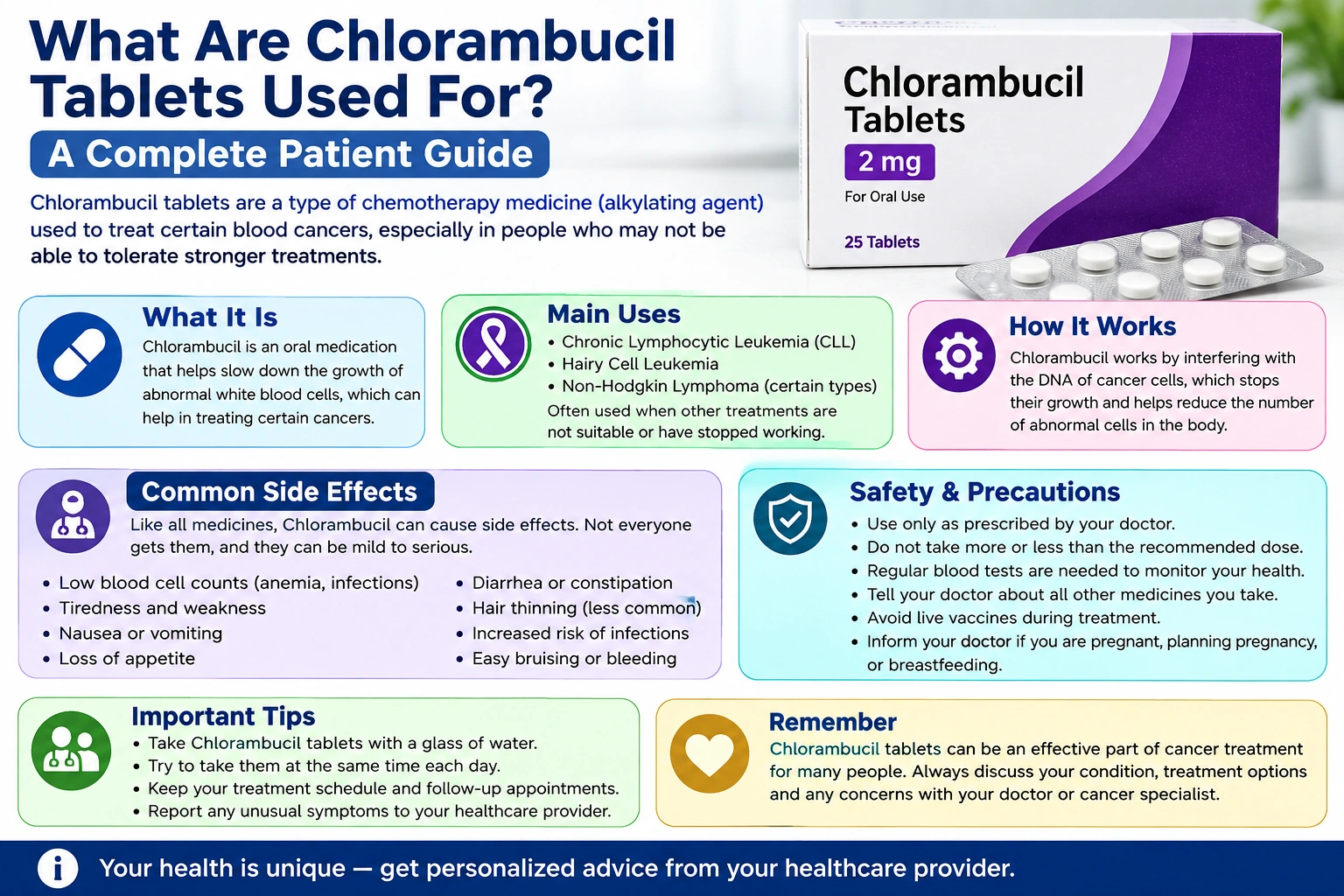
Chlorambucil is a potent cytotoxic, bifunctional nitrogen mustard alkylating chemotherapy agent. It is primarily indicated for treating certain hematologic malignancies, including Chronic Lymphocytic Leukemia (CLL) and specific non-Hodgkin lymphomas. Chlorambucil causes dose-dependent, cumulative bone marrow suppression (neutropenia, anemia, and thrombocytopenia) and is a recognized human carcinogen with potential risks of secondary malignancies. Therapy must strictly be initiated and monitored by an experienced hematologist or medical oncologist with frequent Complete Blood Count (CBC) evaluations. This guide serves strictly educational purposes.
Managing hematologic malignancies—cancers that affect the blood, bone marrow, and lymphatic system—requires systemic therapies that can selectively halt the rapid, uncontrolled proliferation of malignant white blood cells.
Developed as a derivative of nitrogen mustard, **Chlorambucil** has served as a foundational oral chemotherapy agent for decades. Known for its oral convenience and manageable toxicity profile compared to more intensive intravenous regimens, it remains an essential clinical tool—particularly for elderly or frail patients who require gentle, outpatient-based disease management.
Understanding Chlorambucil requires a comprehensive look at its molecular mechanism of alkylation, approved clinical indications, administration and storage rules, side effect profile, and vital safety monitoring protocols.
Mechanism of Action: How Chlorambucil Halts Malignant Cells
Chlorambucil belongs to the nitrogen mustard class of **alkylating antineoplastic agents**. It works by interfering directly with the DNA replication machinery of rapidly dividing cells:
The Molecular Process of Alkylation
1. Formation of Reactive Intermediates: Inside the body, Chlorambucil generates highly reactive carbonium ion intermediates.
2. DNA Cross-Linking: These reactive ions transfer alkyl groups to cellular DNA, specifically binding to the N-7 position of guanine residues. Being a bifunctional alkylating agent, Chlorambucil forms covalent intra-strand and inter-strand cross-links between DNA bases.
3. Halting Replication & Triggering Apoptosis: The cross-links physically distort the DNA double helix, preventing the strands from uncoiling during transcription and DNA replication. This stalls the cell cycle at the $G_2/M$ phase, ultimately triggering programmed cell death (apoptosis) in malignant lymphocytes.
Standard oral oncology preparations—such as Halkeran 2 Mg – Chlorambucil—deliver low-dose, calibrated cytotoxic therapy designed for outpatient disease stabilization.
Primary Clinical Indications
Chlorambucil is primarily prescribed in hematology and oncology for slow-growing (indolent) lymphoid malignancies:
1. Chronic Lymphocytic Leukemia (CLL)
CLL is characterized by the accumulation of mature, yet abnormal, B-cell lymphocytes in the blood, bone marrow, and lymph nodes. Chlorambucil is often used as a gentle oral palliative or disease-controlling therapy, especially in elderly patients or those with multiple co-morbidities who cannot tolerate aggressive chemo-immunotherapy regimens.
2. Malignant Lymphomas (Hodgkin and Non-Hodgkin Lymphoma)
Chlorambucil is indicated for treating indolent low-grade Non-Hodgkin Lymphomas (such as follicular lymphoma) and select cases of Hodgkin lymphoma, often in combination protocols or as maintenance monotherapy.
3. Waldenström’s Macroglobulinemia
Used to control the abnormal lymphoplasmacytic proliferation and IgM paraprotein levels associated with Waldenström’s macroglobulinemia.
4. Off-Label Autoimmune / Refractory Conditions
Historically, low doses of Chlorambucil have been utilized off-label for severe, steroid-resistant autoimmune conditions, such as refractory nephrotic syndrome, systemic lupus erythematosus (SLE), and severe rheumatoid vasculitis, under strict specialist supervision.
Clinical Overview Matrix
The table below summarizes the key pharmacological characteristics, standard indications, and monitoring requirements for Chlorambucil therapy:
| Parameter | Clinical Detail | Monitoring & Safety Requirement |
|---|---|---|
| Drug Class | Nitrogen Mustard Alkylating Agent (Cytotoxic Antineoplastic) | Binds and cross-links cellular DNA to arrest cell division. |
| Primary Indications | Chronic Lymphocytic Leukemia (CLL), Indolent Non-Hodgkin Lymphoma, Waldenström’s Macroglobulinemia | Confirmed hematologic diagnosis and staging required prior to initiation. |
| Administration & Food | Oral ingestion on an empty stomach (1 hr before or 2 hrs after meals) | Food significantly reduces bioavailability; take with water at a consistent time. |
| Critical Safety Metrics | Complete Blood Count (CBC) with differential, platelets, and hepatic/renal panels | Weekly CBC during initial therapy; ongoing checks before each treatment cycle. |
Dosing Schedules, Proper Handling, and Cold-Chain Storage
Because Chlorambucil is a cytotoxic chemotherapy drug, specific storage, handling, and administration precautions must be strictly followed:
1. Common Dosing Schedules
- Intermittent Pulse Therapy: Given as a higher daily dose for 2 to 5 consecutive days every 2 to 4 weeks (e.g., $0.4\text{ to }0.8\text{ mg/kg}$ body weight per pulse). This allows the bone marrow time to recover between cycles.
- Continuous Daily Low-Dose: Given as a daily maintenance dose (typically $0.1\text{ to }0.2\text{ mg/kg/day}$, roughly 4 to 10 mg daily) until disease response occurs, followed by dose reduction.
2. Cold-Chain Storage Requirement (2°C to 8°C)
Chlorambucil tablets are heat-sensitive and chemically unstable at elevated temperatures. Tablets must be stored in a refrigerator ($2^\circ\text{C to }8^\circ\text{C}$ / $36^\circ\text{F to }46^\circ\text{F}$). Do not freeze, and keep the container tightly closed to protect from light and moisture.
3. Cytotoxic Handling Precautions
Swallow tablets whole with a glass of water on an empty stomach. Do not break, crush, chew, or divide the tablets, as inhaling or handling powdered cytotoxic medication can cause local irritation and unwanted drug exposure. Caregivers should wear disposable gloves when handling the tablets.
Potential Adverse Effects and Safety Precautions
While generally better tolerated than IV combination chemotherapy, Chlorambucil requires active safety management:
Key Adverse Reactions & Safety Boundaries
1. Myelosuppression (Bone Marrow Suppression): The primary dose-limiting toxicity. Chlorambucil causes reversible suppression of white blood cells (neutropenia), platelets (thrombocytopenia), and red blood cells (anemia). Weekly blood counts are required; therapy is temporarily paused if neutrophil or platelet counts drop too low.
2. Secondary Malignancies & Carcinogenesis: Long-term use of alkylating agents increases the risk of secondary acute myeloid leukemia (AML) and myelodysplastic syndrome (MDS). Total cumulative doses are kept as low as clinically feasible.
3. Reproductive & Teratogenic Toxicity: Chlorambucil causes amenorrhea in females and azoospermia in males. It is teratogenic and mutagenic; reliable contraception is mandatory for male and female patients during and after treatment.
4. Neurological Toxicity: Rare instances of seizures, hallucinations, or peripheral neuropathy may occur, particularly at high doses or in patients with renal impairment or a history of seizure disorders.
5. Pulmonary & Hepatic Risks: Rare cases of pulmonary fibrosis and hepatotoxicity (jaundice, elevated liver enzymes) have been documented. Baseline liver function tests and chest evaluations are advised.
For an exhaustive, peer-reviewed database detailing the chemical structure, pharmacokinetics, and molecular properties of Chlorambucil, consult the National Center for Biotechnology Information (NCBI) PubChem Database.
For global international health guidelines, regulatory directives, and essential medicine frameworks concerning cancer therapeutics, visit the World Health Organization (WHO) Health Directory.
Chlorambucil Patient Treatment Checklist
Keep these vital clinical guidelines in mind throughout your treatment plan:
- ✔️ Store in the Refrigerator: Always keep your medication refrigerated at 2°C to 8°C (36°F to 46°F).
- ✔️ Take on an Empty Stomach: Swallow tablets whole with water at least 1 hour before or 2 hours after meals.
- ✔️ Never Break or Crush Tablets: Protect yourself and family members from direct exposure to cytotoxic drug powder.
- ✔️ Attend All Scheduled Blood Tests: Regular CBC checks are essential to monitor white blood cells and platelets.
- ✔️ Report Infection Signs Promptly: Contact your oncology team immediately if you develop a fever, chills, sore throat, unusual bruising, or persistent fatigue.