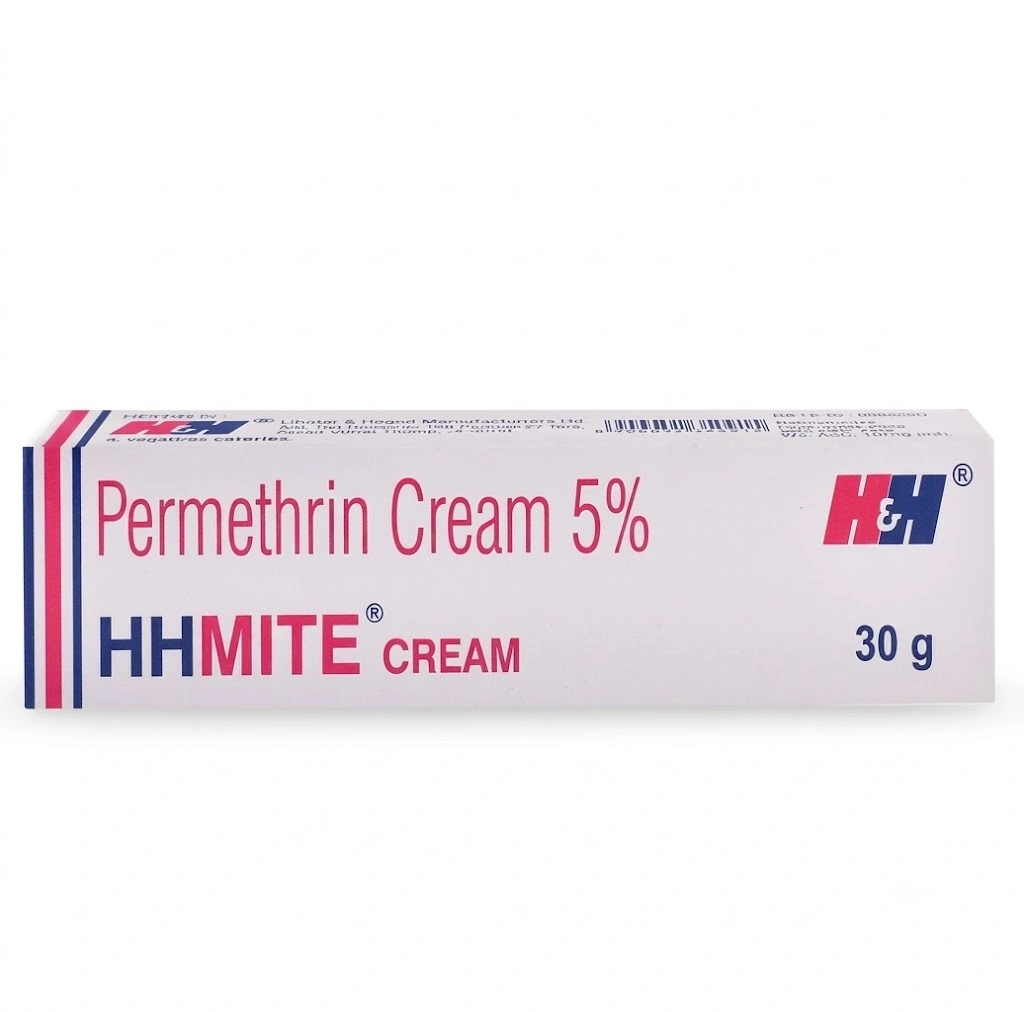
HHMite Cream (Permethrin 5% w/w) – First-Line Scabicidal & Ectoparasiticide Therapy
HHMite Cream (Permethrin 5% w/w) is a synthetic pyrethroid neurotoxic agent indicated as the gold-standard first-line topical treatment for infestation with Sarcoptes scabiei (scabies) in adults and pediatric patients aged 2 months and older. By disrupting voltage-gated sodium channel repolarization in mite nerve cell membranes, it induces rapid paralysis and eradication of both adult parasites and their ova.
Permethrin 5% w/w
Topical Cream
Synthetic Pyrethroid Scabicide
Prescription Dermatological
Active Ingredient
Permethrin
Drug Class
Synthetic Pyrethroid Ectoparasiticide
Dosage Form
Topical Cutaneous Cream
What Is HHMite Cream?
HHMite Cream contains 5% w/w permethrin, a synthetic chemical derivative of naturally occurring pyrethrins harvested from chrysanthemum flowers. It represents the primary recommended frontline therapeutic agent across international clinical dermatological guidelines for managing human scabies infestations.
Unlike older organochlorine scabicides such as lindane, permethrin exhibits low mammalian cutaneous absorption combined with rapid enzymatic degradation by skin esterases. This provides high parasiticicidal efficacy while minimizing systemic toxic exposure in humans.
HHMite Cream is typically administered as a single, thorough overnight whole-body application. Due to the parasite’s life cycle and incubation characteristics, a second application one week later is standard clinical practice to eradicate newly hatched nymphs.
([dailymed.nlm.nih.gov](https://dailymed.nlm.nih.gov/dailymed/lookup.cfm?setid=a00e5ba6-df27-4a00-bebe-8dfda8537b01))
How Does HHMite Cream (Permethrin 5%) Work?
Permethrin acts as a selective neurotoxin specifically targeting the nervous system of arthropod parasites:
- Sodium Channel Disruption: Permethrin selectively binds to the voltage-gated sodium channels along the nerve cell membranes of Sarcoptes scabiei mites.
- Delayed Inactivation: It slows sodium channel deactivation, prolonging inward sodium ion currents across the axonal membrane.
- Exhaustive Depolarization & Paralysis: This induces continuous nerve firing, metabolic exhaustion, complete muscle paralysis, and rapid death of the parasite.
- Ovicidal Action: At 5% topical concentrations, permethrin exhibits significant ovicidal activity, killing unhatched eggs deposited within epidermal burrows.
Because mammal sodium channels possess distinct structural differences and much lower drug binding affinity, permethrin demonstrates a high safety margin when used on human skin.
What Is HHMite Cream Used For?
HHMite Cream is clinically indicated for the eradication of parasitic skin infestations and associated secondary dermatological complications:
- Classical Scabies Infestation: Eradication of Sarcoptes scabiei var. hominis causing nocturnal itching, burrows, and papular lesions across finger webs, wrists, axillae, waistline, and genitalia.
- Pediatric Scabies: Safe management of scabies in infants aged 2 months and older and young children.
- Crusted (Norwegian) Scabies: Used as the topical foundation alongside systemic oral ivermectin for severe, hyperkeratotic infestations.
- Household & Contact Prophylaxis: Asymptomatic close household and sexual contacts must be treated simultaneously to stop inter-host transmission cycles.
HHMite Cream is not indicated for non-parasitic pruritus, general fungal rashes, eczema, or routine bacterial skin infections.
([dailymed.nlm.nih.gov](https://dailymed.nlm.nih.gov/dailymed/lookup.cfm?setid=a00e5ba6-df27-4a00-bebe-8dfda8537b01))
Related Antifungal & Anti-Inflammatory Therapy
Severe groin, web-space, or skin-fold itching may stem from fungal dermatophyte infections or superimposed secondary dermatitis rather than parasitic mites. Explore our clinical profile on broad-spectrum combination antifungal-steroid care:
Candid B Cream (Clotrimazole & Beclomethasone)
HHMite Cream Application Guidelines
Proper full-body application is required to avoid treatment failure and eradicate all hiding parasites:
- Adults & Children Over 2 Years: Thoroughly massage cream into clean, cool, completely dry skin from the neck down to the soles of the feet. Ensure special attention to the interdigital finger and toe spaces, wrists, armpits, navel, buttocks, groin, and under fingernails and toenails.
- Infants & Elderly: In infants aged 2 months and older or elderly patients, the infestation often affects the face, temples, scalp, and forehead. Apply cream to the entire body including the scalp, avoiding eyes, nose, and mouth.
- Contact Time: Leave the cream on the skin for 8 to 14 hours (typically overnight). Wash off thoroughly by taking a cool bath or shower.
- Hand Reapplication: If hands are washed with soap and water within the 8- to 14-hour contact period, reapply cream immediately to the hands.
- Second Application (Day 7 to 14): A repeat application 7 days later is recommended to eliminate newly emerged larvae that survived the initial treatment.
Important Decontamination Protocol:
To prevent re-infestation, all bedding, clothing, and towels used within the prior 4 days must be machine washed in hot water (≥ 60°C) and dried on high heat cycle, or sealed inside an airtight plastic bag for at least 72 hours.
HHMite Cream (Permethrin 5%) vs Candid B Cream
Distinguishing between antiparasitic treatments and antifungal-anti-inflammatory combination therapies is essential for accurate management of pruritic rashes:
| Parameter |
HHMite Cream (Permethrin 5%) |
Candid B Cream (Clotrimazole + Beclomethasone) |
| Active Class |
Synthetic pyrethroid neurotoxic scabicide |
Imidazole antifungal + Corticosteroid |
| Target Pathology |
Sarcoptes scabiei mite infestations |
Fungal tinea infections with active inflammation |
| Application Surface |
Whole body (neck down, including all folds) |
Localized to affected inflamed rash borders |
| Dosing Schedule |
Single 8–14 hr application, repeat on Day 7 |
Twice daily application for 2 to 4 weeks |
| Post-Treatment Itch |
Allergic itch persists 2–4 wks (post-scabetic) |
Directly suppresses itch and erythema via steroid |
Never use topical corticosteroids alone to treat an undiagnosed scabies rash, as steroids suppress the local immune response and can cause scabies incognito, accelerating mite propagation.
Who Should Not Use HHMite Cream?
HHMite Cream is contraindicated or requires specific medical precautions in the following populations:
- Known hypersensitivity to permethrin, any synthetic pyrethroid, or natural pyrethrins/chrysanthemums
- Neonates and infants under 2 months of age (safety and cutaneous clearance mechanisms have not been established)
- Open, extensively secondarily infected wounds or weeping eczematous lesions prior to medical clearance
- Application to mucosal membranes, eyes, mouth, or internal vaginal tissue
- Pregnancy and breastfeeding (permethrin is generally considered low risk due to minimal absorption, but use must be physician-supervised)
Individuals with a history of asthma or severe environmental atopy should use caution during widespread topical application.
([dailymed.nlm.nih.gov](https://dailymed.nlm.nih.gov/dailymed/lookup.cfm?setid=a00e5ba6-df27-4a00-bebe-8dfda8537b01))
Possible Side Effects of HHMite Cream
Permethrin 5% is generally well tolerated, with adverse events limited to cutaneous sensations at the site of application:
- Transient Burning & Stinging: Mild, temporary stinging sensation shortly after application, especially over irritated scratch marks.
- Pruritus Exacerbation: Temporary worsening of itching following mite death, caused by host immunological reaction to dead parasite proteins.
- Local Erythema & Tingling: Mild skin redness, numbness, or tingling (paresthesia).
- Dryness & Peeling: Mild scaling or localized contact dermatitis in sensitive skin types.
Persistent itching for 2 to 4 weeks after successful treatment is common (post-scabetic itch) and does not automatically indicate treatment failure.
([dailymed.nlm.nih.gov](https://dailymed.nlm.nih.gov/dailymed/lookup.cfm?setid=a00e5ba6-df27-4a00-bebe-8dfda8537b01))
Interactions and Precautions
Because systemic absorption of permethrin 5% through intact human skin is less than 2% of the applied dose, systemic drug-drug interactions are clinically negligible:
Corticosteroid Interference: Concomitant use of high-potency topical steroids during the active infestation may impair the cutaneous inflammatory clearance of mites. Steroids should be reserved for residual post-scabetic itch after confirmed mite eradication.
Warm Baths & Absorption: Do not apply HHMite Cream immediately after taking a hot, steamy bath. Warm baths cause peripheral vasodilation and hydrate the stratum corneum, which can increase unwanted systemic drug absorption and reduce cutaneous surface retention. Skin should be completely cool and dry before application.
([dailymed.nlm.nih.gov](https://dailymed.nlm.nih.gov/dailymed/lookup.cfm?setid=a00e5ba6-df27-4a00-bebe-8dfda8537b01))
Post-Scabetic Pruritus Management
The intense nocturnal itch of scabies is a type IV delayed hypersensitivity reaction against mite bodies, eggs, and fecal pellets (scybala).
Even after complete parasitic death from permethrin, the retained dead antigens within the stratum corneum continue triggering host immune mast-cell degranulation until the skin naturally sheds over 2 to 4 weeks. Oral antihistamines, soothing calamine lotion, or mild topical hydrocortisone can be used to manage this post-treatment itch under dermatological guidance.
When Is Retreatment Truly Necessary?
A second application 7 to 14 days after the first is routine to eradicate newly hatched nymphs. Beyond that, retreatment is indicated only if:
- New, active, visible cutaneous burrows emerge after 14 days.
- Live, motile mites or viable eggs are microscopically confirmed via skin scrapings.
- Severe, escalating nocturnal itching persists beyond 4 weeks post-treatment.
Repeated daily use of permethrin is unnecessary, does not speed itch resolution, and causes severe chemical irritant dermatitis.
([dailymed.nlm.nih.gov](https://dailymed.nlm.nih.gov/dailymed/lookup.cfm?setid=a00e5ba6-df27-4a00-bebe-8dfda8537b01))
Frequently Asked Questions About HHMite Cream
1. Why do I still itch after using HHMite Cream?
Itching often persists for 2 to 4 weeks after successful treatment. This “post-scabetic itch” is an allergic reaction to the dead mites and debris remaining in the skin, which continues until the skin naturally sheds its outer layer.
([dailymed.nlm.nih.gov](https://dailymed.nlm.nih.gov/dailymed/lookup.cfm?setid=a00e5ba6-df27-4a00-bebe-8dfda8537b01))
2. Do family members without symptoms need to use HHMite Cream?
Yes. Scabies has an incubation period of 2 to 6 weeks during which an individual can transmit mites without showing symptoms. All household members and close physical contacts should be treated simultaneously to prevent cross-infestation.
3. Can I use HHMite Cream on my face and scalp?
In adults, scabies rarely affects the head, so application from the neck down is standard. However, in infants under 2 years, elderly patients, or crusted scabies cases, the face, scalp, and neck should be treated, taking care to avoid the eyes, nose, and mouth.
([dailymed.nlm.nih.gov](https://dailymed.nlm.nih.gov/dailymed/lookup.cfm?setid=a00e5ba6-df27-4a00-bebe-8dfda8537b01))
4. What should I do if I wash my hands during the treatment period?
If you wash your hands with soap and water within the 8- to 14-hour contact window, reapply the cream to your hands, wrists, and web spaces immediately to ensure continuous drug exposure.
5. How is HHMite Cream different from Candid B Cream?
HHMite Cream contains permethrin 5%, an antiparasitic scabicide designed to kill scabies mites. Candid B Cream contains an antifungal (clotrimazole) and a steroid (beclomethasone) for fungal infections. Candid B will not kill scabies mites and can worsen mite infestations if misapplied.
Medical Disclaimer
This product overview is provided strictly for educational and informational purposes. HHMite Cream (permethrin 5% w/w) is a prescription dermatological preparation requiring appropriate diagnosis by a qualified medical practitioner or dermatologist. Dosing regimens, household contact prophylaxis, and diagnostic confirmation are required for clinical resolution. This content does not substitute for personalized medical diagnosis, advice, or treatment.






Reviews
There are no reviews yet.