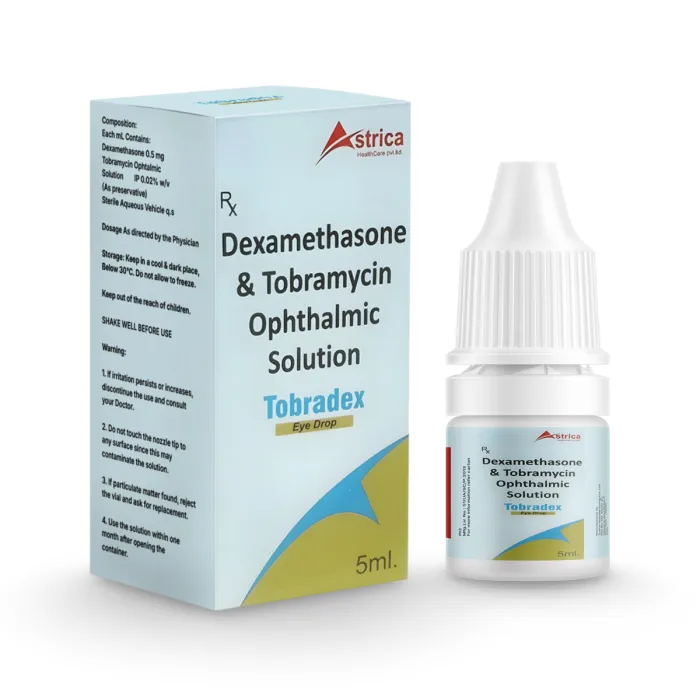
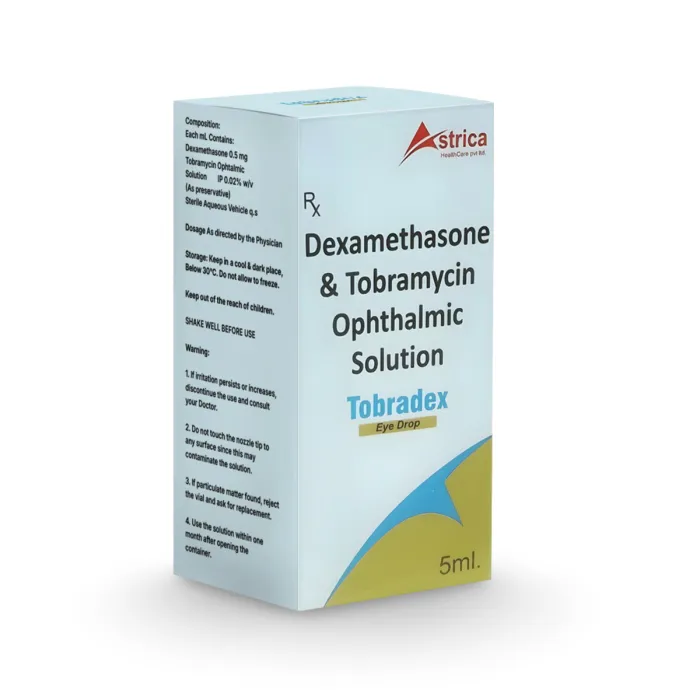
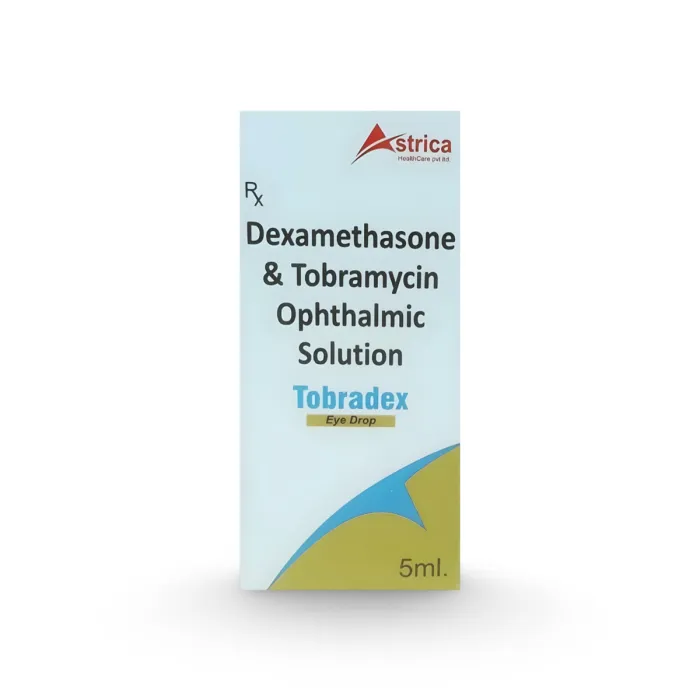
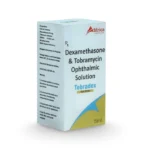
Tobradex 0.1% / 0.3% Eye Drop – Dual Antibiotic & Anti-Inflammatory Ophthalmic Suspension
Tobradex 0.1% / 0.3% Eye Drop is a fixed-combination sterile ophthalmic suspension containing the synthetic corticosteroid dexamethasone (0.1%) and the aminoglycoside antibiotic tobramycin (0.3%). It is indicated for steroid-responsive inflammatory ocular conditions where superficial bacterial ocular infection or a risk of bacterial ocular infection exists, suppressing ocular tissue inflammation while providing broad-spectrum bactericidal defense.
Dexamethasone 0.1%
Tobramycin 0.3%
Steroid + Antibiotic Combination
Prescription Ophthalmic
Active Ingredients
Dexamethasone + Tobramycin
Concentration
0.1% / 0.3% w/v
Therapeutic Class
Corticosteroid & Aminoglycoside Antibacterial
Dosage Form
Sterile Ophthalmic Suspension
What Is Tobradex 0.1% / 0.3% Eye Drop?
Tobradex is a precision ophthalmic suspension combining an anti-inflammatory glucocorticoid (dexamethasone 1 mg/mL) with a water-soluble aminoglycoside antibiotic (tobramycin 3 mg/mL). It is designed to manage complex ocular presentations where tissue inflammation and bacterial contamination co-exist.
While corticosteroids inhibit the body’s inflammatory defense mechanisms and may heighten susceptibility to microbial colonization, the co-formulation of tobramycin provides antimicrobial coverage against common Gram-positive and Gram-negative ocular pathogens, preventing opportunistic bacterial overgrowth during anti-inflammatory treatment.
Tobradex is prescribed for short-term acute courses, frequently following anterior segment surgery (such as cataract extraction) or for severe inflammatory anterior segment conditions. Therapy requires close monitoring of intraocular pressure (IOP) by an eye care specialist.
([dailymed.nlm.nih.gov](https://dailymed.nlm.nih.gov/dailymed/drugInfo.cfm?setid=07622d13-64a6-455b-bf6c-6745582fca12))
How Does Tobradex Work?
Tobradex exerts its clinical efficacy through complementary pharmacological actions:
- Corticosteroid Anti-Inflammatory Action (Dexamethasone): Dexamethasone crosses cell membranes to bind intracellular glucocorticoid receptors. This complex inhibits phospholipase A2 via lipocortin induction, suppressing the release of arachidonic acid and decreasing the synthesis of prostaglandins and leukotrienes. It also inhibits leukocyte infiltration, vascular permeability, and fibroblast proliferation to reduce swelling, fibrin deposition, and capillary dilation.
- Bactericidal Protein Synthesis Inhibition (Tobramycin): Tobramycin binds irreversibly to the 30S ribosomal subunit of susceptible bacteria. This causes misreading of the genetic code and halts bacterial protein synthesis, destabilizing the cell envelope and leading to rapid bacterial lysis. It provides potent coverage against Staphylococcus aureus, Staphylococcus epidermidis, and Pseudomonas aeruginosa.
This combined mechanism resolves anterior segment inflammation while controlling or preventing secondary bacterial proliferation.
What Is Tobradex Eye Drop Used For?
Tobradex is indicated for steroid-responsive inflammatory ocular conditions where superficial bacterial infection or a risk of infection exists:
- Post-Surgical Ocular Inflammation: Routine prevention and control of inflammation and bacterial infection following cataract, refractive, or glaucoma surgery.
- Inflammatory Conjunctivitis: Palpebral and bulbar conjunctivitis complicated by susceptible bacterial involvement.
- Anterior Segment Uveitis: Suppression of anterior chamber cellular flare and pain where infectious risk is present.
- Blepharoconjunctivitis & Keratitis: Severe inflammation of the lid margins, conjunctiva, and superficial cornea with secondary bacterial risk.
- Chemical, Radiation, or Thermal Burns: Protection against corneal scarring, symblepharon formation, and bacterial invasion during epithelial healing.
Tobradex is contraindicated in epithelial herpes simplex keratitis (dendritic keratitis), vaccinia, varicella, and fungal or mycobacterial ocular infections.
([dailymed.nlm.nih.gov](https://dailymed.nlm.nih.gov/dailymed/drugInfo.cfm?setid=07622d13-64a6-455b-bf6c-6745582fca12))
Related Ophthalmic Therapy
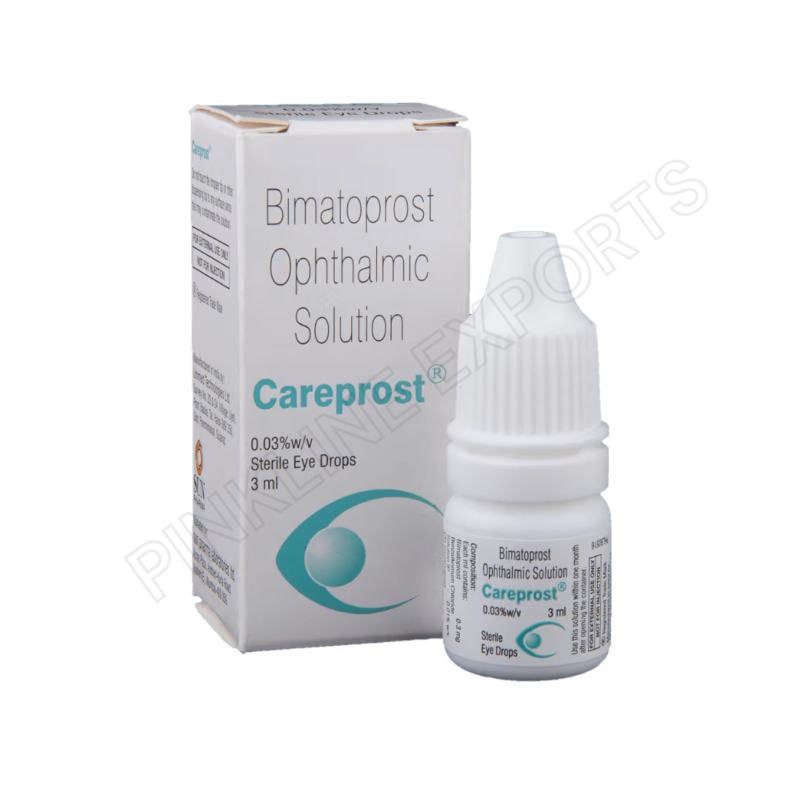
While steroid-antibiotic suspensions manage acute anterior segment inflammation and surgical recovery, prostanoid therapies target aqueous outflow dynamics and intraocular pressure control. Explore our product overview for bimatoprost:
Careprost 0.03% 3ml – Bimatoprost Eye Drops
Tobradex Dosage and Administration Guidelines
Dosage frequency is tailored to the severity of the inflammatory condition under ophthalmic supervision:
- Standard Dosage: Instill 1 to 2 drops into the conjunctival sac of the affected eye(s) every 4 to 6 hours.
- Initial Severe Therapy: During the initial 24 to 48 hours of severe inflammation or acute post-operative phases, the dose may be increased to 1 or 2 drops every 2 hours.
- Dose Tapering: Dosing frequency must be reduced gradually as clinical signs improve. Therapy should not be discontinued abruptly to prevent rebound inflammation.
- Shake Well: Always shake the bottle thoroughly before each use to ensure uniform redispersion of insoluble dexamethasone particles.
To prevent contamination, avoid touching the dropper tip to eyelids, eyelashes, or any surface. Apply gentle punctal pressure at the inner corner of the eye for 1 minute post-instillation to minimize systemic absorption.
([dailymed.nlm.nih.gov](https://dailymed.nlm.nih.gov/dailymed/drugInfo.cfm?setid=07622d13-64a6-455b-bf6c-6745582fca12))
Important Duration & Contact Lens Warning:
Do not use continuously for more than 10 to 14 days without intraocular pressure monitoring. Do not wear contact lenses while receiving treatment for ocular inflammation or bacterial infection.
Tobradex vs Careprost 0.03% (Bimatoprost)
Comparing an acute anti-inflammatory/antibacterial suspension with a chronic pressure-lowering prostamide highlights their distinct clinical roles:
| Parameter |
Tobradex (Dexamethasone + Tobramycin) |
Careprost 0.03% (Bimatoprost) |
| Therapeutic Class |
Corticosteroid & Aminoglycoside Antibiotic |
Prostamide / Prostaglandin Analog |
| Primary Indication |
Ocular inflammation & bacterial infection risk |
Open-angle glaucoma & ocular hypertension |
| Impact on Intraocular Pressure |
May elevate IOP (steroid-induced ocular hypertension) |
Lowers IOP (enhances uveoscleral/trabecular outflow) |
| Dosing Schedule |
Every 4 to 6 hours (short-term, tapered course) |
Once daily in the evening (long-term maintenance) |
| Formulation Type |
Suspension (requires shaking prior to use) |
Clear aqueous solution |
Tobradex is prescribed for acute inflammatory flare-ups and surgical care, whereas Careprost is indicated for ongoing intraocular pressure management or eyelash stimulation.
Who Should Not Use Tobradex Eye Drop?
Tobradex is contraindicated in patients with specific viral, fungal, or structural corneal conditions:
- Epithelial herpes simplex keratitis (dendritic keratitis), where corticosteroids exacerbate viral replication and can cause corneal perforation
- Vaccinia, varicella, and other viral diseases of the cornea and conjunctiva
- Mycobacterial infections of the eye (such as ocular tuberculosis)
- Fungal infections of ocular structures or untreated parasitic ocular infestations
- Known hypersensitivity to tobramycin, dexamethasone, other aminoglycosides, or formulation excipients
- Undiagnosed “red eye” presentations where corneal ulceration or viral etiology has not been ruled out via slit-lamp examination
Corticosteroids should be used with extreme caution in patients with a personal or family history of open-angle glaucoma.
([dailymed.nlm.nih.gov](https://dailymed.nlm.nih.gov/dailymed/drugInfo.cfm?setid=07622d13-64a6-455b-bf6c-6745582fca12))
Possible Side Effects of Tobradex
Adverse reactions may result from the corticosteroid component, the antibacterial component, or their combination:
- Elevated Intraocular Pressure (IOP): Steroid-induced ocular hypertension, which may lead to glaucoma and optic nerve damage if unmonitored.
- Posterior Subcapsular Cataract Formation: Associated with prolonged or repeated topical corticosteroid use.
- Secondary Ocular Infections: Fungal corneal invasion is particularly common with long-term steroid therapy; secondary bacterial infections may also develop from immunosuppression.
- Delayed Wound Healing: Corticosteroids can retard corneal epithelial repair and thinning, increasing the risk of corneal perforation in diseases causing thinning.
- Local Irritation & Hypersensitivity: Ocular hyperemia, punctate keratitis, burning, stinging, eyelid pruritus, and conjunctival edema (most commonly aminoglycoside hypersensitivity).
If severe eye pain, foreign body sensation, worsening discharge, or visual changes develop, seek immediate ophthalmic re-evaluation.
([dailymed.nlm.nih.gov](https://dailymed.nlm.nih.gov/dailymed/drugInfo.cfm?setid=07622d13-64a6-455b-bf6c-6745582fca12))
Drug Interactions and Co-Administration Guidelines
Systemic exposure following topical ocular instillation of Tobradex is low, but local interactions require attention:
Staggering Topical Medications: If other eye drops are prescribed (such as glaucoma medications, NSAID drops, or artificial tears), separate instillation times by at least 5 to 10 minutes. Always administer suspensions like Tobradex last to prevent them from being washed out by clear solutions.
Systemic Aminoglycosides: Concomitant use with systemic aminoglycoside antibiotics (e.g., intravenous tobramycin, gentamicin) requires monitoring of total serum drug concentrations to avoid cumulative ototoxic or nephrotoxic risks.
CYP3A4 Inhibitors: Co-administration with strong CYP3A4 inhibitors (such as ritonavir or cobicistat) may reduce dexamethasone clearance, potentially increasing systemic corticosteroid exposure.
([dailymed.nlm.nih.gov](https://dailymed.nlm.nih.gov/dailymed/drugInfo.cfm?setid=07622d13-64a6-455b-bf6c-6745582fca12))
Clinical Monitoring & IOP Assessment
Because topical corticosteroids can cause steroid-induced ocular hypertension in susceptible “steroid responders,” specific clinical monitoring protocols must be followed:
Tonometry (IOP Checks): If Tobradex is administered for 10 days or longer, intraocular pressure should be measured routinely with tonometry. Approximately one-third of the population demonstrates clinically significant IOP elevation after 2 to 4 weeks of ocular steroid therapy.
Slit-Lamp Examination: Regular biomicroscopy and fluorescein staining should be performed to monitor corneal epithelial integrity and detect early signs of fungal keratitis or persistent ulceration.
([dailymed.nlm.nih.gov](https://dailymed.nlm.nih.gov/dailymed/drugInfo.cfm?setid=07622d13-64a6-455b-bf6c-6745582fca12))
Aseptic Handling and Storage
Tobradex ophthalmic suspension contains benzalkonium chloride as an antimicrobial preservative:
Store the container upright at controlled room temperature ($2^\circ\text{C to }25^\circ\text{C}$). Keep the cap tightly sealed when not in use. To ensure sterility and prevent bacterial contamination, discard any remaining suspension 4 weeks after opening the bottle.
Frequently Asked Questions About Tobradex Eye Drop
1. Why must the Tobradex bottle be shaken before each use?
Tobradex is an ophthalmic suspension rather than a clear solution. Shaking the bottle thoroughly ensures that the suspended microfine particles of dexamethasone are uniformly dispersed, providing the correct therapeutic dose with every drop.
([dailymed.nlm.nih.gov](https://dailymed.nlm.nih.gov/dailymed/drugInfo.cfm?setid=07622d13-64a6-455b-bf6c-6745582fca12))
2. Can Tobradex cause an increase in eye pressure?
Yes. The dexamethasone component can raise intraocular pressure (IOP) in susceptible individuals, potentially leading to glaucoma or optic nerve compromise if left unmonitored. When therapy extends beyond 10 days, regular eye pressure checks are essential.
3. Can I wear contact lenses while using Tobradex?
No. Contact lenses should not be worn during treatment for active ocular inflammation or bacterial infection. Additionally, the preservative benzalkonium chloride can be absorbed by soft lenses and cause corneal toxicity.
([dailymed.nlm.nih.gov](https://dailymed.nlm.nih.gov/dailymed/drugInfo.cfm?setid=07622d13-64a6-455b-bf6c-6745582fca12))
4. Why is Tobradex tapered off rather than stopped abruptly?
Abruptly stopping a potent ocular corticosteroid can cause rebound inflammation (a flare-up of anterior segment swelling and redness). Gradually tapering the dose gives the ocular tissues time to stabilize.
5. What is the difference between Tobradex and Careprost?
Tobradex is a short-term combination of a steroid (dexamethasone) and an antibiotic (tobramycin) used to treat acute inflammation and prevent bacterial infection. Careprost contains bimatoprost, a prostaglandin analog used long-term to lower intraocular pressure in glaucoma or to treat eyelash hypotrichosis.
Medical Disclaimer
This product overview is provided strictly for educational and informational purposes. Tobradex 0.1% / 0.3% Eye Drop (dexamethasone and tobramycin) is a prescription ophthalmic medication that must only be initiated, dosed, and monitored under the care of a licensed ophthalmologist or optometrist. Periodic intraocular pressure measurement and biomicroscopy are required during treatment. This document does not replace professional medical evaluation, diagnosis, or individualized ophthalmic care.




Reviews
There are no reviews yet.