


How Spegra Works: Understanding Dolutegravir, Emtricitabine and Tenofovir Alafenamide

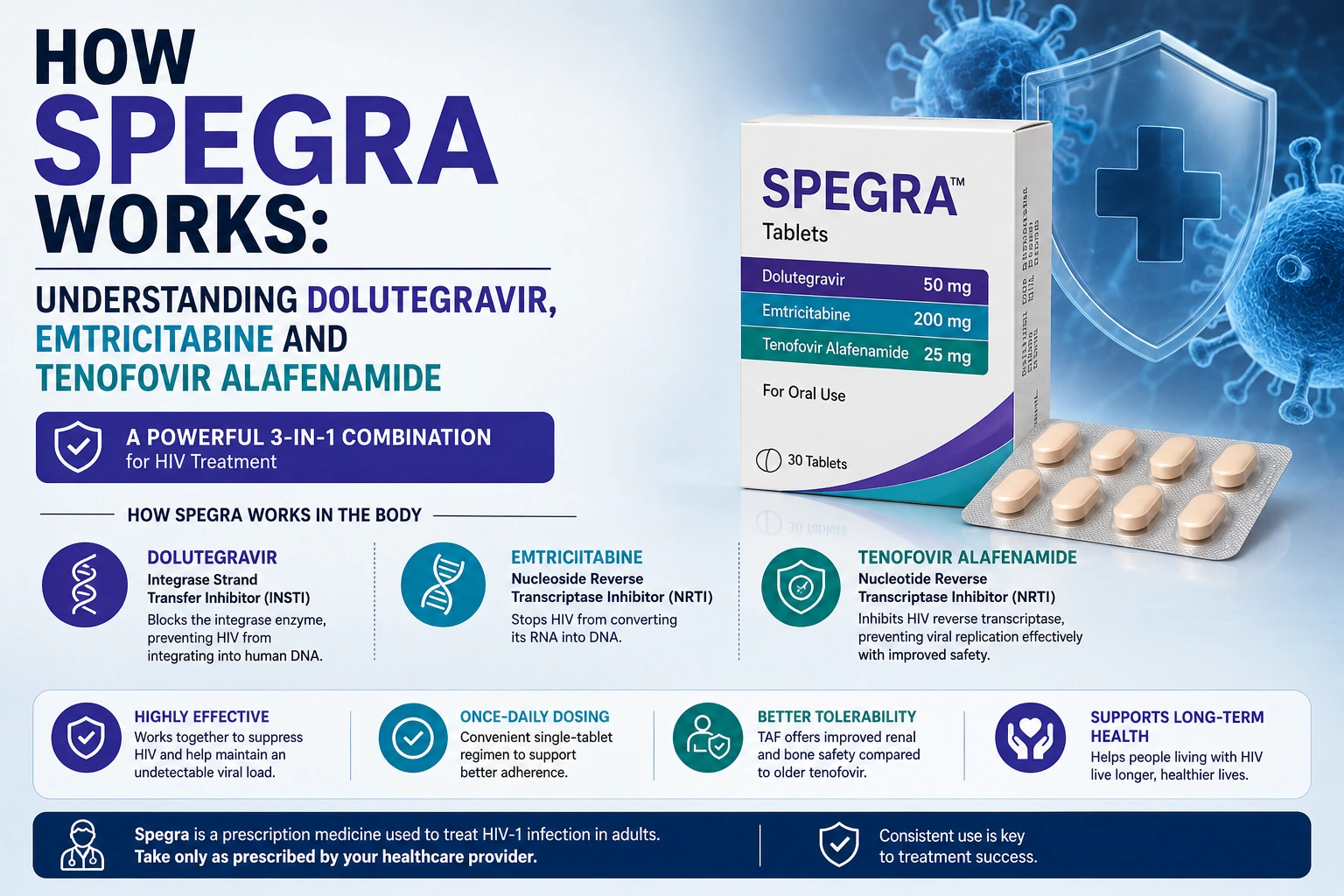
How Spegra Works: Understanding Dolutegravir, Emtricitabine, and Tenofovir Alafenamide
Critical Medical & Antiretroviral Safety Notice
Spegra is a complete, single-tablet regimen (STR) combining three antiretroviral agents: Dolutegravir (50 mg), Emtricitabine (200 mg), and Tenofovir Alafenamide (25 mg). It is indicated for the treatment of Human Immunodeficiency Virus Type 1 (HIV-1) infection in adult and pediatric patients meeting specific clinical criteria. Strict adherence to daily dosing is essential to prevent treatment failure and the emergence of viral resistance. Therapy must only be initiated and monitored under the care of a licensed infectious disease specialist. This document serves strictly educational purposes.
The management of Human Immunodeficiency Virus (HIV-1) has been transformed by modern Combination Antiretroviral Therapy (cART). By combining multiple drugs targeting different stages of the viral life cycle into a single daily tablet, antiretroviral regimens achieve rapid, sustained viral suppression while reducing medication burden.
Among complete single-tablet regimens, **Spegra** represents a widely prescribed combination pairing an **Integrase Strand Transfer Inhibitor (INSTI)** with two **Nucleoside/Nucleotide Reverse Transcriptase Inhibitors (NRTIs)**. This multi-target approach stops viral replication while maintaining a high barrier to drug resistance.
Understanding how Spegra works requires examining the distinct mechanism of action of each component—Dolutegravir, Emtricitabine, and Tenofovir Alafenamide—its clinical advantages, potential side effects, and essential treatment guidelines.
Triple-Action Mechanism: How the Three Ingredients Work Together
HIV-1 relies on specific enzymes inside host immune cells (CD4+ T-lymphocytes) to replicate. Spegra interrupts this process at two distinct stages using three active ingredients:
The Molecular Mechanism of Spegra
1. Dolutegravir (50 mg – Integrase Inhibitor): Dolutegravir targets the HIV integrase enzyme. After the virus converts its RNA into DNA, it uses integrase to insert its genetic code into the host cell’s genome. Dolutegravir blocks this integration step, preventing the virus from taking over host cellular machinery to create new viral copies.
2. Emtricitabine (200 mg – NRTI): A nucleoside reverse transcriptase inhibitor. Emtricitabine acts as a false building block (cytidine analogue) during reverse transcription. When reverse transcriptase incorporates Emtricitabine into growing viral DNA strands, it triggers premature chain termination, halting viral DNA synthesis.
3. Tenofovir Alafenamide / TAF (25 mg – NtRTI): A novel nucleotide reverse transcriptase inhibitor prodrug. Like Emtricitabine, TAF blocks reverse transcription. However, TAF is engineered to deliver the active drug directly into CD4+ cells and lymphoid tissue at significantly lower plasma concentrations than older forms of tenofovir (such as Tenofovir Disoproxil Fumarate / TDF), markedly reducing bone and renal toxicity risks.
Clinicians prescribe complete fixed-dose combination formulations—such as HIV Combination Tablets—to ensure high patient adherence and prevent single-drug resistance.
Component Summary Matrix
The table below outlines the pharmacological classifications, cellular targets, and key safety features of each active agent in Spegra:
| Active Ingredient | Pharmacological Class | Target Viral Mechanism | Primary Clinical Advantage |
|---|---|---|---|
| Dolutegravir (50 mg) | Integrase Strand Transfer Inhibitor (INSTI) | Inhibits HIV Integrase enzyme, blocking viral DNA integration. | Rapid viral load suppression with a high genetic barrier to resistance. |
| Emtricitabine (200 mg) | Nucleoside Reverse Transcriptase Inhibitor (NRTI) | Causes DNA chain termination during viral RNA-to-DNA transcription. | Proven long-term efficacy and favorable tolerability profile. |
| Tenofovir Alafenamide (25 mg) | Nucleotide Reverse Transcriptase Inhibitor (NtRTI) | Inhibits reverse transcriptase with targeted intracellular delivery. | Significantly lower risk of renal impairment and bone mineral density loss compared to TDF. |
Clinical Advantages of the Spegra Regimen
The combination of Dolutegravir, Emtricitabine, and Tenofovir Alafenamide offers several clinical advantages in modern HIV care:
- High Barrier to Resistance: Dolutegravir’s high genetic resistance barrier makes it difficult for HIV-1 to develop mutations that cause treatment failure, even if an occasional dose is missed.
- Improved Renal and Bone Safety Profile: By utilizing Tenofovir Alafenamide (TAF) rather than older tenofovir formulations, Spegra causes significantly less impact on kidney function (glomerular filtration) and bone mineral density over long-term therapy.
- Single-Tablet Simplicity: Combining three potent agents into one daily tablet simplifies daily routines, increasing adherence and improving long-term viral suppression.
- Broad Efficacy: Recommended as a complete regimen for both treatment-naïve individuals starting therapy for the first time and stable patients replacing their current regimen.
Administration & Critical Drug Interactions
Proper administration habits are essential to ensure consistent, therapeutic blood levels:
1. Daily Administration Rules
Spegra is taken as one tablet once daily, with or without food. Taking the tablet at the same time each day helps maintain steady antiretroviral concentrations in the bloodstream.
2. Cation Interaction Warning (Antacids & Supplements)
Integrase inhibitors like Dolutegravir bind to polyvalent cations (such as aluminum, magnesium, calcium, or iron), which significantly reduces their absorption:
- Cation-containing antacids must be taken at least 2 hours after or 6 hours before taking Spegra.
- Calcium or iron supplements can be taken at the same time as Spegra only if taken with food; otherwise, observe the same separation timing.
3. Screening for Hepatitis B Co-infection
Both Emtricitabine and Tenofovir Alafenamide possess activity against the Hepatitis B Virus (HBV). Patients must be screened for chronic Hepatitis B before starting therapy. Discontinuing Spegra in HBV co-infected patients can cause severe acute exacerbation of Hepatitis B; monitoring liver function is essential if treatment is stopped.
For a deep dive into official peer-reviewed clinical summaries, trial records, and pharmacology profiles on antiretroviral compounds, consult the National Center for Biotechnology Information (NCBI) PubChem Database.
For global clinical directives and international HIV treatment guidelines, visit the official World Health Organization (WHO) HIV/AIDS Directory.
Spegra Treatment Safety Checklist
Keep these essential guidelines in mind to optimize your treatment outcomes:
- ✔️ Take Every Day: Take your single tablet once daily at the same time each day to maintain viral suppression.
- ✔️ Separate Antacids and Supplements: Space out antacids or mineral supplements (calcium, iron, magnesium) to prevent absorption issues.
- ✔️ Screen for Hepatitis B: Ensure your physician performs Hepatitis B screening before starting or stopping therapy.
- ✔️ Monitor Viral Load and CD4 Count: Keep up with routine lab visits to confirm complete viral suppression.
- ✔️ Never Discontinue Unsupervised: Stopping antiretroviral therapy can lead to rapid viral rebound and drug resistance.