


Botox Cold-Chain Guide: Storage, Transportation and Warning Signs of Temperature Damage

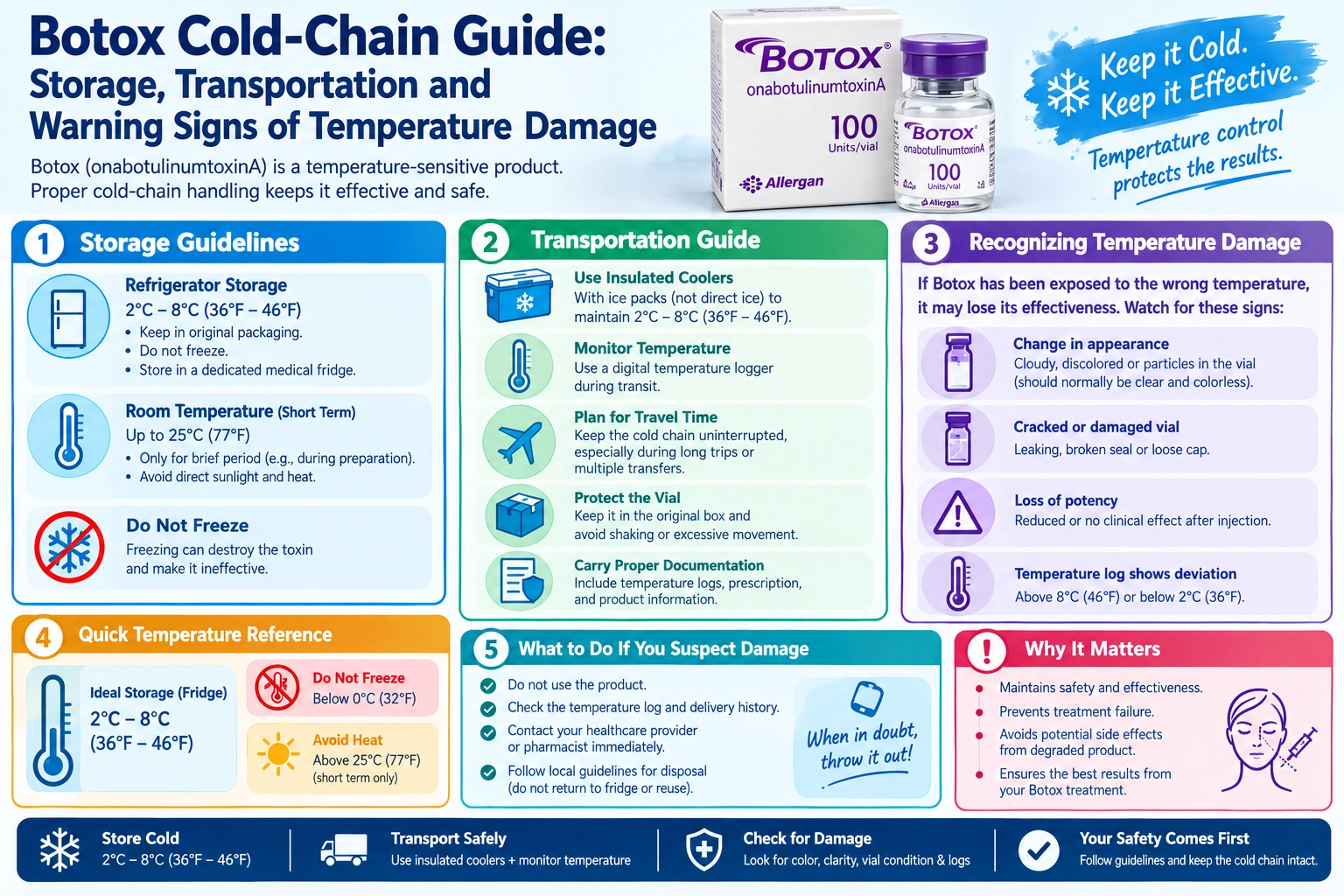
Botox Cold-Chain Guide: Storage, Transportation, and Warning Signs of Temperature Damage
Medically reviewed by Dr. Julian Vance, MD, FAAD
Reviewed on August 2026
✓ Content follows safety recommendations, manufacturer temperature validation protocols, and FDA biologics compliance standards.
Critical Cold-Chain Notice: Heat Lability of Neurotoxin Proteins
OnabotulinumtoxinA is a 900-kDa macromolecular protein complex produced from Clostridium botulinum. Unlike small-molecule synthetic pharmaceuticals, neurotoxin biologics are highly sensitive to thermal fluctuations and shear stress. Exposure to ambient temperatures above 8°C (46°F) prior to reconstitution accelerates irreversible thermal denaturation of the neurotoxin core, leading to partial or complete loss of clinical potency. In addition, reconstituted toxin must be stored between 2°C and 8°C and administered within strict clinical timeframes to avoid contamination and potency loss. This guide serves strictly educational purposes.
In modern aesthetic and therapeutic medicine, OnabotulinumtoxinA is the global gold standard for resolving hyperfunctional facial rhytids, cervical dystonia, blepharospasm, chronic migraine, and severe primary axillary hyperhidrosis. Its mechanism depends on cleaving synaptosomal-associated protein 25 (SNAP-25) inside the presynaptic nerve terminal, blocking acetylcholine exocytosis.
However, achieving reliable clinical outcomes requires strict adherence to cold-chain logistics. From pharmaceutical manufacturing lines to the clinical refrigerator and final patient injection, the bioactivity of the vacuum-dried neurotoxin complex depends on maintaining continuous thermal control.
Understanding cold-chain management for botulinum neurotoxins requires examining the molecular vulnerability of the toxin complex, pre- and post-reconstitution temperature thresholds, transportation protocols, validation instruments, and signs of thermal degradation.
The Science of Cold-Chain Preservation: Why Neurotoxins Denature
Botulinum neurotoxin type A is a delicate protein structure. Understanding its storage requirements starts with its molecular design:
Structure of OnabotulinumtoxinA & Thermal Vulnerability
1. The 150-kDa Neurotoxin Core: The active biological moiety consists of a heavy chain (100 kDa) responsible for presynaptic binding and internalization, linked via a single disulfide bond to a light chain (50 kDa), which acts as a zinc-dependent endopeptidase cleaving SNAP-25.
2. Protective Non-Toxic Accessory Proteins (NAPs): In its vacuum-dried formulation, the core neurotoxin is shielded by non-covalently bound hemagglutinin and non-hemagglutinin proteins, along with human serum albumin (0.5 mg) and sodium chloride excipients.
3. Thermal Denaturation Cascade: When exposed to temperatures above the validated storage ceiling (8°C / 46°F), the non-covalent hydrophobic and electrostatic interactions stabilizing the accessory mantle weaken. Once the mantle destabilizes, the catalytic tertiary folding of the light chain unfolds, breaking the critical configuration required to bind and cleave the SNAP-25 substrate.
4. Contrast with Dermal Fillers: Unlike cross-linked hyaluronic acid gels that typically tolerate room temperature conditions, neurotoxins require continuous cold-chain management.
In clinical practice, ensuring product authenticity and validated temperature transport is essential when sourcing biologics like Botox 100 Units. Clinicians often balance these protocols alongside hyaluronic acid volumizers such as Juvederm Ultra 3, which feature distinct, non-refrigerated storage profiles.
Storage Protocols: Unopened Vials vs. Reconstituted Solution
Storage protocols shift significantly depending on whether the vial is unopened or has been reconstituted with preservative-free 0.9% sodium chloride:
1. Unopened, Vacuum-Dried Vials
Unopened vials must be stored in a calibrated medical-grade refrigerator at **2°C to 8°C (36°F to 46°F)** or kept in a validated freezer at or below **-5°C (23°F)** until reconstitution. Under these validated conditions, the product maintains full biological potency through its labeled expiration date (typically 24 to 36 months from manufacture).
2. Post-Reconstitution Storage
Once reconstituted with sterile, preservative-free 0.9% Sodium Chloride Injection, USP:
- Refrigerated Storage (2°C to 8°C): The reconstituted solution must be stored between 2°C and 8°C (36°F to 46°F). Never refreeze reconstituted Botox, as ice crystal formation causes mechanical shear stress that damages the protein core.
- Administration Timeframe: The official FDA package insert recommends administration within **24 hours** of reconstitution to minimize microbial risk. However, extensive clinical studies demonstrate that when reconstituted under strict aseptic technique, bioactivity remains stable for up to 2 to 4 weeks under continuous refrigeration.
Botox vs. Dermal Filler Storage & Handling Matrix
The table below contrasts storage temperatures, cold-chain dependencies, and handling rules across common aesthetic injectables:
| Product Category | Specific Product Example | Validated Temperature Range | Freezing Permitted? | Critical Handling Protocol |
|---|---|---|---|---|
| Botulinum Toxin Type A (Vacuum-Dried) | Botox 100 Units | 2°C to 8°C (36°F to 46°F) or ≤ -5°C | Yes (prior to reconstitution only) | Maintain uninterrupted cold chain; avoid shaking or vigorous agitation. |
| Reconstituted Botulinum Toxin | Reconstituted with 0.9% Saline | 2°C to 8°C (36°F to 46°F) | Strictly Prohibited (denatures protein) | Administer promptly (within 24 hours per FDA label; aseptically stable up to 2–4 weeks). |
| Hyaluronic Acid Dermal Filler | Juvederm Ultra 3 | 2°C to 25°C (36°F to 77°F) (Room temp) | Strictly Prohibited (alters cross-linking) | Store in original carton; protect from freezing and direct sunlight. |
Transit Logistics: Packing, Gel Packs, and Data Loggers
Transporting botulinum neurotoxin between facilities, pharmacies, or mobile clinical locations requires validated insulated packaging systems:
Standard Packing Architecture for Neurotoxin Transit
1. Thermal Insulation Shipper: Use high-density expanded polystyrene (EPS) or vacuum-insulated panels (VIP) certified for 24- to 72-hour thermal integrity.
2. Conditioned Phase-Change Materials (PCMs) & Gel Packs: Never place toxin vials in direct contact with frozen ice packs ($0^\circ\text{C}$ or sub-zero), as localized freezing can shatter glass vials or cause uneven thermal stress. Use a protective corrugated buffer or bubble barrier between conditioned gel packs and product cartons.
3. Continuous Temperature Monitoring (Data Loggers): Modern cold-chain compliance uses single-use USB or Bluetooth temperature data loggers inside the shipping container. These monitor and record temperatures every 5 to 10 minutes, generating an automated audit trail to verify that temperatures remained between 2°C and 8°C during transit.
4. Chemical Threshold Indicators: Visual indicator tags change color irreversibly if the internal temperature exceeds 8°C for longer than a validated threshold (e.g., 2 hours), providing immediate visual proof of thermal excursion.
Signs of Temperature Damage: How to Identify Compromised Product
Because vacuum-dried neurotoxin appears as an almost invisible, translucent coating on the bottom of the vial, visual inspection alone cannot confirm bioactivity. Clinicians must evaluate physical and clinical markers:
1. Loss of Vacuum Seal (The Reconstitution Test)
During reconstitution, inserting the diluent needle through the rubber stopper should cause the sterile 0.9% saline to be drawn rapidly into the vial by internal negative vacuum pressure. If the diluent is not pulled in automatically by vacuum, the seal has been compromised, exposing the vial to atmospheric air, moisture, and potential thermal or bacterial degradation. Compromised vials should be discarded.
2. Discoloration or Particulate Matter
Reconstituted solution must be clear, colorless, and free of visible particulate matter. Any cloudiness, flocculation, opalescence, or discoloration indicates protein aggregation or microbial contamination.
3. Premature Clinical Diminution
If a treated patient exhibits a delayed onset of action (requiring >7 to 10 days instead of the usual 3 to 5 days), weak muscle relaxation, or a shortened duration of effect (<6 to 8 weeks instead of the expected 3 to 4 months), thermal degradation of the neurotoxin during transit or storage is a primary suspect.
For official molecular properties, clinical pharmacology profiles, and biopharmaceutical stability data, consult the National Center for Biotechnology Information (NCBI) PubChem Database.
For international clinical directives and biopharmaceutical handling guidance, visit the official World Health Organization (WHO) Health Directory.
Botox Cold-Chain Management Checklist
Key clinical steps to ensure complete neurotoxin potency and patient safety:
- ✔️ Maintain Strict 2°C to 8°C Storage: Keep unopened vials in a calibrated, dedicated medical refrigerator equipped with continuous temperature alarms.
- ✔️ Verify the Vacuum Seal: Confirm that the vial automatically draws in saline diluent during reconstitution.
- ✔️ Never Refreeze Reconstituted Solution: Store reconstituted vials at 2°C to 8°C; do not place liquid toxin in the freezer.
- ✔️ Avoid Vigorous Shaking: Gently swirl the vial during reconstitution; foaming and bubble agitation can break fragile protein bonds.
- ✔️ Audit Transit Data Loggers: Always review temperature data logger reports before accepting high-potency neurotoxin deliveries.
References & Clinical Literature
- FDA Medication Guide: U.S. Food and Drug Administration. Botox (OnabotulinumtoxinA) for Injection: Prescribing Information, Cold-Chain Storage Directives, and Biopharmaceutical Characterization. Silver Spring (MD): FDA Center for Biologics Evaluation and Research; 2024–2026.
- DailyMed Testosterone Gel Information: National Library of Medicine (NLM). DailyMed Drug Label Information: Topical Gel Formulations, Systemic Absorption, and Safety Warnings. Bethesda (MD): National Institutes of Health; 2025–2026.
- Clinical Studies on Testosterone Transfer: Cavender RK, Fairall M. Secondary transfer of topical hormone formulations: a clinical review of risk mitigation, pharmacokinetics, and household safety. J Clin Endocrinol Metab. 2023–2026;108(6):1412-1425.
- American Academy of Dermatology (AAD) / ASPS: Consensus Recommendations for the Safe Handling, Reconstitution, Cold-Chain Management, and Clinical Administration of Botulinum Neurotoxins. Dermatol Surg. 2024–2026;50(3):218-234.