.svg)



Average Age for Balls to Drop: Puberty Stages, Signs & Medical Facts


Last Updated: May 2026
Average Age for Balls to Drop: Puberty Stages, Signs & Medical Facts
Average age for balls to drop is one of the most searched puberty questions online. Most boys begin puberty between ages 9 and 14, when the testicles enlarge, hormone levels rise, and normal male development begins.
Although the phrase “balls dropping” is commonly used, medically it may refer to two different biological processes:
- Testicles descending into the scrotum before or shortly after birth
- Testicles enlarging and hanging lower during puberty
Understanding the difference is important because one process is part of normal puberty, while the other may require medical evaluation or treatment.
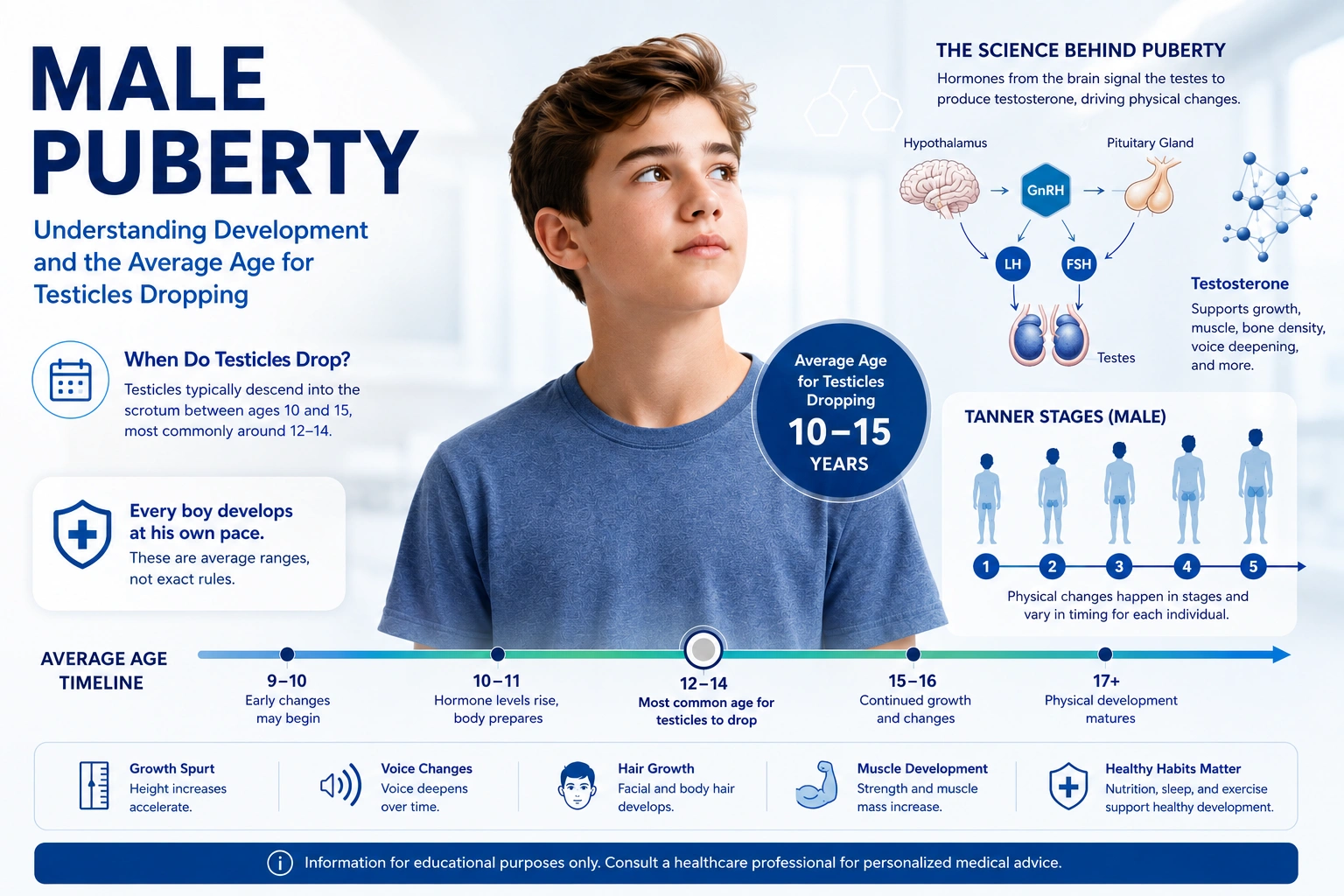
Average Age for Balls to Drop During Puberty
Most boys begin puberty between ages 9 and 14. One of the earliest signs is enlargement of the testicles. As puberty progresses, the scrotum becomes looser and the testicles naturally hang lower.
The average age for balls to drop varies between individuals because genetics, hormones, nutrition, and overall health influence puberty timing.
What Does Average Age for Balls to Drop Mean?
In casual conversation, “balls dropping” usually refers to puberty. During this stage, the testicles start producing higher amounts of testosterone and sperm. As the scrotum develops, the testicles naturally hang lower than during childhood.
However, medically speaking, testicles actually begin developing before birth. In most male babies, they descend into the scrotum before delivery or shortly afterward.
| Condition | Typical Age | What Happens |
|---|---|---|
| Puberty-related development | 9–14 years | Testicles enlarge and scrotum hangs lower |
| Undescended testicles (Cryptorchidism) | Birth to infancy | One or both testicles fail to descend into the scrotum |
Average Age for Balls to Drop and Puberty Development
Puberty starts at different ages for different boys. Genetics, nutrition, hormones, sleep, and overall health can all influence development.
For most boys, puberty begins between ages 9 and 14. One of the first noticeable changes is enlargement of the testicles.
As puberty progresses:
- The testicles grow larger
- The scrotum becomes thinner and darker
- Pubic hair starts developing
- The voice deepens
- Muscle mass increases
- Facial and underarm hair appear
The average age for balls to drop is considered normal anywhere within the typical puberty range, although development speed differs between individuals.
Tanner Stages and the Average Age for Balls to Drop
Doctors use the Tanner Scale to measure physical development during puberty. These stages track genital growth, body hair, and other puberty changes.
Tanner Stage 1
This is the pre-puberty stage. No visible changes are present yet, although hormones begin preparing the body internally.
Tanner Stage 2
Usually between ages 9 and 11, the testicles begin enlarging and the scrotum starts changing texture and color.
Tanner Stage 3
Growth becomes more noticeable during this stage. Height increases rapidly, pubic hair thickens, and the voice may begin deepening.
Tanner Stage 4
The penis and testicles continue growing. Acne, facial hair, and stronger body odor become more common. Related skin care treatment categories may help support acne and hormone-related skin concerns commonly experienced during puberty.
Tanner Stage 5
This marks full physical maturity. Adult genital size is reached and growth slows down significantly.
Signs Related to Average Age for Balls to Drop
Many teenagers worry whether puberty is happening normally. In most cases, puberty develops gradually over several years.
- Testicle enlargement
- Growth spurts
- Pubic and underarm hair
- Deeper voice
- Acne and oily skin
- Increased sweating
- Facial hair growth
- Muscle development
Delayed Puberty and Average Age for Balls to Drop
Doctors may consider puberty delayed if testicle enlargement has not started by age 14.
Delayed puberty can happen because of genetics, hormonal disorders, chronic illness, poor nutrition, or excessive athletic training. Because hormones play a central role in puberty, doctors may sometimes evaluate endocrine function and testosterone levels. Explore related testosterone replacement therapy (TRT) and hormonal treatment categories .
Many boys with delayed puberty eventually develop normally, but medical evaluation may still be recommended.
Undescended Testicles vs Average Age for Balls to Drop
Undescended testicles are very different from puberty-related development. Before birth, the testicles develop inside the abdomen and normally move into the scrotum during late pregnancy.
If one or both testicles fail to descend, the condition is called cryptorchidism.
According to the Mayo Clinic , undescended testicles are more common in premature infants.
Some pediatric urologists may also evaluate associated urinary or reproductive conditions. Related urology treatment categories may provide additional educational resources regarding male reproductive health.
Frequently Asked Questions About Average Age for Balls to Drop
What is the average age for balls to drop?
Most boys begin puberty between ages 9 and 14, and testicle enlargement is usually one of the earliest signs.
Is it normal for one testicle to hang lower?
Yes. In most males, one testicle naturally hangs slightly lower than the other.
Can puberty start early?
Yes. Some boys begin puberty around ages 8–9 depending on genetics and hormone levels.
When should delayed puberty be evaluated?
Doctors may evaluate delayed puberty if no testicle enlargement has occurred by age 14.
Are undescended testicles serious?
Undescended testicles may increase risks of infertility and testicular cancer if left untreated.
Final Thoughts on Average Age for Balls to Drop
The phrase “balls dropping” is commonly used to describe puberty, but medically it may refer either to puberty-related genital development or undescended testicles in infants.
For most boys, puberty starts naturally between ages 9 and 14 and continues gradually over several years. Testicle enlargement is one of the earliest signs of healthy male development.