.svg)



Can Fenbendazole Cure Cancer? Scientific Research, Case Studies & Risks


Fenbendazole which is a medication originally created for veterinary use, has garnered a lot of attention online in recent years as a potential alternative cancer treatment. This antiparasitic drug may have anticancer effects and these assertions are frequently backed up by anecdotal success stories, which can be persuasive, particularly for people who are diagnosed with severe or advanced cancer.
Fenbendazole belongs to a class of medications which is called as benzimidazole anthelmintics. It is mostly used to treat all the illnesses caused by parasitic worms in animals like dogs, horses, and cattle. It functions by disrupting the parasites' cellular structure, precisely focusing on microtubules, which are crucial for cell division and for its survival. Although this method works well against the parasites, regulatory bodies like the U.S. Food and Drug Administration or other comparable international organizations have not authorized fenbendazole to use in humans.
There are no clear recommendations for its use in humans, and no standardized dose instructions due to the lack of human approval. When evaluating claims regarding its possible use in cancer treatment, this distinction is crucial. After using fenbendazole, a few people have reported some improvements in their condition but a thorough investigation shows that these patients were also getting standard cancer therapies like chemotherapy, and radiation therapy.
Medical Authorities Recommendation
Prominent medical associations always makes sure that fenbendazole is neither a recommended medicine nor it is an authorized cancer treatment. Oncologists and cancer research organizations agree that patients should refrain from using any self medication using unproven substances because there is not any evidence to justify its usage. Healthcare practitioners may highlight the significance of evidence-based treatment strategies, which are backed by stringent clinical testing. Any possible treatment must go through a thorough review process before being deemed safe for humans, even if research into new medicines is still under process.
Fenbendazole are researched at the preclinical stage and researchers are looking into how it works and whether it is useful in all the combo treatments. Nevertheless, there is now no obvious route for clinical adoption. These initiatives are still in their infancy and finding new applications for already-approved drugs is known as "drug repurposing," and it is a respectable and worthwhile field of study.
Possible Dangers
The absence of proven safety evidence for human use is one of the issues with fenbendazole and its effects on the human body are little understood because it is not authorized for usage in humans and elevated liver enzymes and inflammation have been reported as signs of possible liver damage.
Chemotherapy or targeted therapies may be less effective or more likely to have negative side effects when used with unapproved drugs. Reliance on experimental therapies may also cause delays in accessing evidence-based care, which could have a detrimental effect on results and in many situations, the lack of medical supervision raises these risks even more because patients could not obtain the proper care or monitoring if issues develop.
Possible Mechanisms of Fenbendazole
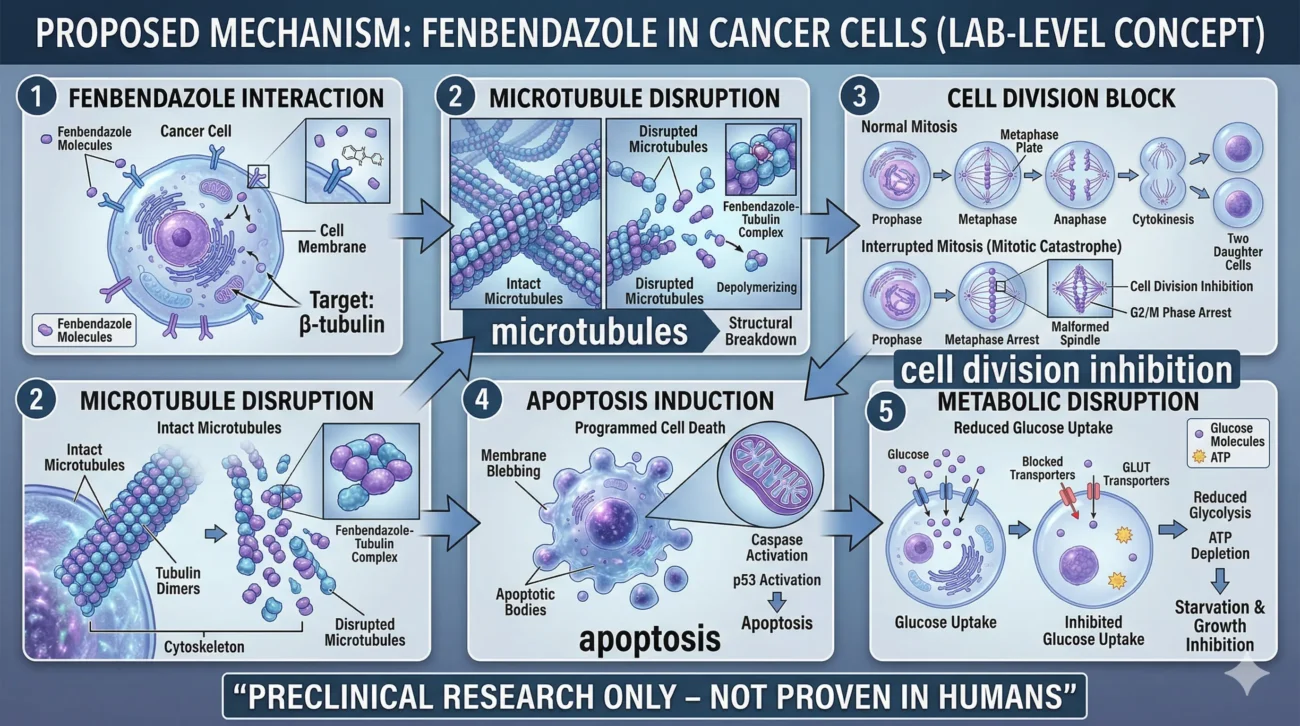
Fenbendazole may disrupt microtubules in a manner similar to chemotherapeutic treatments, according to research as interfering with microtubules, which are crucial for cell division, can stop cancer cells from proliferating. The effects of fenbendazole in labs have sparked the role of scientific interest in the drug's potential to treat cancer.
The information for assessing the treatment of cancer comes from human clinical studies and there is a gap in this area when it comes to fenbendazole and as of 2026, there were no peer reviewed clinical trials proving the efficacy of fenbendazole in treating human cancer. According to a research, fenbendazole may cause cancer cells to undergo apoptosis. It can result in programmed cell death, in addition to disrupting microtubules. Additionally, there is evidence that it may disrupt cellular metabolism, specifically glucose absorption, which is frequently increased in cancer cells.
Comparing Approved Cancer Treatments with Fenbendazole
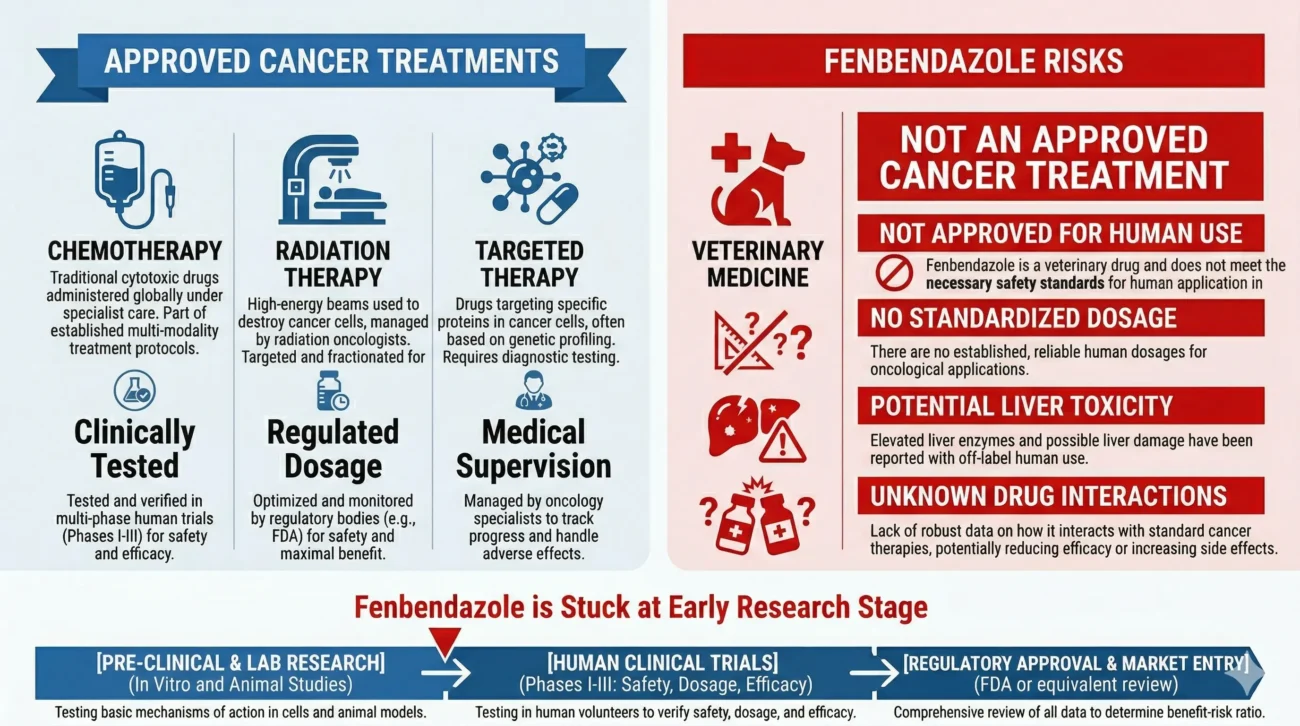
Comprehensive clinical evidence supporting the safety of approved cancer treatments is available and these therapies have been tested in several stages, including extensive studies with a variety of patient demographics and they are given under medical supervision and follow established guidelines for dosage, side effect management, and monitoring.
Fenbendazole does not have these protections and regulatory approval, a regulated dosage schedule, and trustworthy data attesting to its advantages in people are all lacking. Medical authorities strongly advise against using it as a replacement for proven medicines because of this striking disparity.
Fenbendazole is not the feasible cancer treatment and also, is not an clinical usage from medical point of view due to the lack of proof and the safety hazards. Patients are advised to speak with medical specialists. They can look into evidence-based treatments that are customized for their illness and integrative oncology is a methodical, and scientifically based framework for individuals who are interested in alternative methods. In this discipline, supportive therapies are tested for efficacy and safety which are combined with all the traditional treatments.
Why the recommendation for fenbendazole continues to grow?
To ensure safe care, it is crucial to have a scientific proof, even though the desire for correct answers is natural. Despite the lack of evidence in the recent times, the growing interest in fenbendazole continues to grow. The new trend of fenbendazole in recent times reflects the broad challenges that have emerged in the usage of cancer care. The access of online information when it is combined with the spread of unverified rights, has contributed to the popularity of all fenbendazole over the world.
A person's experience may be impacted by a variety of factors, including concurrent therapies, differences in the biology of diseases, and all other psychological concerns. While the desire for new solutions is still understandable, it is essential to ensure that a safe and effective care must be followed by all patients. Additionally, all positive outcomes are probably going to be reported. But neutral encounters may also go unreported, which would skew the notion of efficacy.
Conclusion
Fenbendazole is a drug that has no use in the treatment of cancer as of now and there is no clinical evidence that will prove its efficacy in people. But there are some laboratory researches suggesting some anticancer effects. As of 2026, fenbendazole cannot be regarded as a cancer cure. When making decisions regarding their care, patients should consult medical specialists and give priority to evidence based therapies. Its usage in oncology is currently unsupported, although more research may offer more clarity in the future.
FAQ'S
Can fenbendazole help to treat human cancer?
Since there is no solid clinical evidence to support its efficacy, fenbendazole cannot be regarded as a human cancer cure
Is the use of fenbendazole declared as a safe option to use for people?
The safety profile of fenbendazole in humans is not well known, and it potential adverse effects, such as liver damage and drug interactions, are a concern.
Why do some individuals think that the usage of fenbendazole is effective?
Online testimonials and anecdotal reports are the main sources of belief in fenbendazole's efficacy. Since many people making these claims are getting conventional therapies also, it is impossible to identify the real reason for the improvement.
Medically reviewed by: Dr. Neil K, GP and Medical Researcher
Review date: 02-04-2026
Disclaimer: This article is for educational purposes only and does not replace professional medical advice. Always consult a licensed healthcare provider before starting or changing any medication